Sleepwalking: What Causes It, Who Is at Risk, and How to Prevent It
Sleepwalking (ICD-10: F51.3) is a sleep disorder where a person walks or performs actions while still asleep. It happens during Stage 3 NREM sleep — the deepest part of the sleep cycle. Sleep deprivation, stress, fever, genetics, and certain medications are the main causes. Up to 30% of children will sleepwalk at least once, according to the American Academy of Sleep Medicine (AASM).
What Is Sleepwalking?
Sleepwalking — also called somnambulism — is a type of parasomnia (a sleep disorder that causes abnormal behavior during sleep). A person who sleepwalks gets up, moves around, and sometimes speaks — all while still asleep. They have no memory of the episode after waking.
The AASM classifies sleepwalking as a Non-REM Sleep Arousal Disorder. The ICD-10 code for sleepwalking is F51.3. The DSM-5 places it in the same category under "Non-Rapid Eye Movement Sleep Arousal Disorders."
Sleepwalking affects an estimated 1–15% of the general population at some point in their lives, according to the AASM and Stanford Sleep Medicine. To understand more about the full range of sleep disorders sleepwalking fits within, read our guide on signs you have a sleep disorder.
How Does Sleepwalking Differ from Other Parasomnias?
Parasomnias are a group of sleep disorders. They include night terrors, REM Sleep Behavior Disorder (RBD), and sleepwalking. Sleepwalking differs from night terrors because night terrors cause intense fear and screaming — but the person stays in bed. RBD causes people to act out vivid dreams during REM sleep. Sleepwalking involves complex movement during NREM sleep — with no dreaming.
Example: A child with night terrors screams and appears terrified but stays in bed. A child who sleepwalks may calmly walk to the kitchen, open the fridge, and return to bed — with no memory of any of it.
What Happens in the Brain During a Sleepwalking Episode?

Brain activity during sleepwalking: the motor cortex activates while the prefrontal cortex stays in deep sleep.
The brain does not fully wake up during a sleepwalking episode. Instead, it experiences thalamo-cortical dissociation — a state where only part of the brain activates. The thalamus is a relay station in the brain that controls sleep and wakefulness.
During this dissociation, the motor cortex (which controls movement) partially wakes up. The prefrontal cortex — the part of the brain responsible for judgment, decision-making, and memory — stays in deep sleep. This is why sleepwalkers can walk, open doors, and even speak, but cannot make safe decisions or remember the event.
This model explains the core contradiction of sleepwalking: the body moves while the conscious mind remains asleep.
The deeper science of sleep stages is covered in our guide on the 5 stages of sleep.
How Long Does a Typical Sleepwalking Episode Last?
Most sleepwalking episodes last between 30 seconds and 30 minutes. Some brief episodes end with the person returning to bed on their own. Longer episodes carry a higher injury risk because the person may walk further from their sleeping area.
Episodes almost always occur in the first third of the night — when Stage 3 NREM sleep (slow-wave sleep) is most dominant. This timing helps distinguish sleepwalking from nightmares, which happen during the REM phase in the second half of the night.
What Causes Sleepwalking?
The seven main cause categories that trigger sleepwalking episodes.
Sleepwalking does not have a single cause. Multiple triggers can disrupt the brain's ability to complete a normal sleep cycle. Each trigger below interferes with NREM slow-wave sleep in a different way — but all lead to the same partial arousal that produces a sleepwalking episode.
| Cause Category | Mechanism | Most Affected Group |
|---|---|---|
| Sleep Deprivation | Increases slow-wave sleep pressure; disrupts arousal threshold | All ages |
| Genetics | Inherited predisposition to arousal disorder | Children with family history |
| Fever / Illness | Disrupts normal sleep architecture | Children aged 4–8 |
| Medications (e.g., Zolpidem) | Suppresses natural arousal signaling | Adults |
| Alcohol | Suppresses REM; increases NREM rebound | Adults |
| Stress / Anxiety | Elevates overnight arousal threshold disruption | Adults |
| Sleep Apnea (OSA) | Causes micro-arousals in NREM sleep | Adults, especially middle-aged |
How Does Sleep Deprivation Trigger Sleepwalking Episodes?
Sleep deprivation increases the brain's pressure to enter slow-wave sleep. When the brain is sleep-deprived, it drives deeper and more intense Stage 3 NREM sleep. This depth makes partial arousal — the mechanism behind sleepwalking — more likely.
The brain fights to stay in deep sleep while external or internal signals push for waking. The result is the in-between state that causes sleepwalking.
Research confirms that even one night of sleep loss increases the frequency of sleepwalking episodes in people already prone to the disorder. Chronic sleep deprivation compounds this risk over time. Learn more about whether you may be affected in our article on chronic sleep deprivation signs and risks.
Which Genetic Factors Increase the Likelihood of Sleepwalking?
Genetics plays a strong role in sleepwalking risk. If one parent has a history of sleepwalking, the child has approximately a 45% chance of sleepwalking. If both parents have a history, that figure rises to approximately 60%, according to research cited by the AASM.
Emerging research has also identified links between specific HLA antigen types (proteins on the surface of immune cells) and parasomnia predisposition. This suggests that the biological tendency toward thalamo-cortical dissociation may be heritable at the genetic level.
Sleepwalking runs in families — and family history is one of the strongest predictors a doctor uses when assessing risk.
How Do Fever and Illness Cause Sleepwalking in Children?
Fever disrupts normal sleep architecture. When a child has a high fever, the brain's regulation of sleep stages becomes unstable. This instability increases the likelihood of partial arousal during slow-wave sleep.
Illness-related sleepwalking in children is temporary. Episodes stop once the fever breaks and sleep returns to normal. However, parents should monitor for repeat episodes after illness, as they may signal an underlying predisposition.
Example: A 6-year-old with a 39°C (102°F) fever from a respiratory infection may sleepwalk for the first time during that illness. If episodes do not continue after recovery, fever was the only trigger.
Which Medications Are Linked to Sleepwalking as a Side Effect?
The U.S. Food and Drug Administration issued a black box warning — the highest level of drug warning — requiring sedative-hypnotic sleep medications including Zolpidem (Ambien), Eszopiclone (Lunesta), and Zaleplon (Sonata) to carry explicit warnings about complex sleep behaviors. These behaviors include sleepwalking, sleep-driving, and other actions performed while not fully awake. The FDA stated these behaviors could result in serious injury or death.
Other medications linked to sleepwalking include:
- Some antidepressants (e.g., selective serotonin reuptake inhibitors)
- Lithium (used for bipolar disorder)
- Beta-blockers (used for heart conditions and anxiety)
- Some antihistamines and antipsychotics
Anyone who begins sleepwalking after starting a new medication should contact their prescribing doctor promptly.
How Does Alcohol Consumption Affect Sleepwalking Risk?
Alcohol suppresses REM sleep during the first half of the night. As alcohol metabolizes later in the night, the brain rebounds — increasing NREM slow-wave sleep pressure. This rebound creates the same unstable arousal conditions that trigger sleepwalking.
Alcohol does not directly cause sleepwalking in people with no predisposition. However, in people with a personal or family history of sleepwalking, even moderate alcohol consumption can trigger an episode. Avoiding alcohol within 4 hours of bedtime is a standard clinical recommendation for people prone to sleepwalking.
Can Stress and Anxiety Cause Sleepwalking in Adults?
Stress and anxiety elevate the brain's overnight arousal signals. This disrupts the normal progression through sleep stages and increases the chance of partial waking during slow-wave sleep.
Adults with PTSD (Post-Traumatic Stress Disorder) show higher rates of sleepwalking than the general population. PTSD alters sleep architecture significantly — fragmenting slow-wave sleep and increasing micro-arousals throughout the night.
Example: An adult who sleepwalked occasionally as a child may experience a return of episodes during a period of high work stress or after a traumatic event. In this case, stress management becomes a direct part of sleepwalking prevention.
How Do Sleep Disorders Like Sleep Apnea Contribute to Sleepwalking?
Sleep apnea (formally: Obstructive Sleep Apnea or OSA) causes repeated pauses in breathing during sleep. Each pause triggers a brief arousal — called a micro-arousal — as the brain forces the airway to reopen.
These micro-arousals fragment sleep architecture. When they occur during slow-wave sleep, they create exactly the conditions that trigger sleepwalking. This process is called sleep architecture fragmentation.
Research published in Sleep Medicine found that treating sleep apnea with CPAP therapy significantly reduced sleepwalking episodes in adults with both conditions. This confirms that OSA is not a coincidence with sleepwalking — it is a direct contributing mechanism. Read more in our detailed article on sleep apnea health risks you should know.
Who Is Most Likely to Sleepwalk?
Sleepwalking risk varies by age, family history, and coexisting health conditions.
Sleepwalking is not equally distributed across age groups or family backgrounds. Clear patterns exist in the data — and understanding them helps identify who needs preventive action.
| Population Group | Sleepwalking Prevalence | Key Risk Factor |
|---|---|---|
| Children aged 4–8 | Up to 30% (at least once) | Developmental NREM dominance |
| Children aged 8–12 | Declining from peak | NREM patterns stabilizing |
| Adults (general) | 2–4% with disorder criteria | Comorbid conditions, medications |
| Adults with 1 parent history | ~45% lifetime risk | Genetic predisposition |
| Adults with 2 parent history | ~60% lifetime risk | Strong genetic predisposition |
| Adults with PTSD | Significantly elevated | Fragmented NREM architecture |
Why Is Sleepwalking More Common in Children Than Adults?
Children spend more time in Stage 3 NREM (slow-wave) sleep than adults do. This deeper, longer slow-wave sleep creates more opportunities for partial arousal. As children age, the proportion of slow-wave sleep decreases — and sleepwalking frequency typically drops alongside it.
Up to 30% of children between ages 4 and 12 will sleepwalk at least once, according to the AASM. The peak age of occurrence is 4 to 8 years. Most children outgrow sleepwalking by early adolescence without any treatment.
Does Sleepwalking Run in Families?
Sleepwalking has a clear hereditary pattern. Studies show that the arousal disorder mechanism underlying sleepwalking is inherited. If one parent sleepwalked as a child, their child faces a 45% chance of sleepwalking. If both parents have a history, that risk rises to approximately 60%.
This does not mean sleepwalking is inevitable — but children from families with a history of sleepwalking need closer monitoring, especially when other triggers (fever, sleep deprivation) are present.
Are Adults Who Sleepwalk More Likely to Have a Psychiatric Condition?
Adult-onset or adult-persistent sleepwalking shows stronger links to psychiatric conditions than childhood sleepwalking does. Studies published in Sleep journal found that adults who sleepwalk show higher rates of depression, anxiety disorders, and PTSD compared to the general population.
This does not mean every adult who sleepwalks has a psychiatric condition. However, when an adult begins sleepwalking without a history of childhood episodes, doctors routinely screen for underlying mental health conditions and medication effects.
Which Age Group Has the Highest Prevalence of Sleepwalking?
Children aged 4 to 8 years have the highest prevalence of sleepwalking. This age range aligns with the period of maximum slow-wave sleep dominance in the developing brain. Prevalence data from the AASM places the peak occurrence squarely within this window.
By comparison, only 2–4% of adults meet the clinical criteria for a sleepwalking disorder. Adult sleepwalking that persists or starts after age 18 warrants medical investigation.
Is Sleepwalking Dangerous?
Sleepwalking carries real physical risks — especially when episodes involve leaving the bedroom.
Sleepwalking carries real physical risks. The sleepwalking person has no conscious awareness of their surroundings, cannot judge hazards, and cannot respond normally to danger — because the prefrontal cortex (responsible for judgment) remains asleep.
What Injuries Can Occur During a Sleepwalking Episode?
The most common sleepwalking injuries involve falls. Sleepwalkers have fallen down stairs, walked into furniture, and tripped on objects on the floor. More serious injuries — including fractures, lacerations, and concussions — have been documented in clinical literature.
Common injury types include:
- Falls on stairs or from elevated surfaces
- Cuts and bruises from walking into furniture or doors
- Burns from attempting to use a stove or microwave
- Fractures from significant falls, especially in adults
Children face lower injury rates than adults because episodes are typically shorter and confined to familiar bedroom environments. Adults, especially those whose episodes involve leaving the bedroom, face the highest injury risk.
Can a Sleepwalker Drive or Leave the House While Asleep?
A sleepwalker can leave the house. Documented cases exist of sleepwalkers walking outside, getting in cars, and in rare cases, driving short distances. These episodes involve complex, automated behaviors that do not require full conscious awareness.
The risk of leaving the home is higher in adults with severe or frequent episodes. This is one reason why sleepwalking has appeared as a legal defense in court cases. Courts in Canada, the UK, and the United States have addressed the legal concept of "automatism" — where a person commits an act without conscious awareness. Forensic sleep medicine experts have testified in criminal trials involving actions taken during documented sleepwalking states.
Securing doors and windows at night is a priority safety step for households with a known sleepwalker.
Is It Dangerous to Wake Someone Who Is Sleepwalking?
"You should never wake a sleepwalker — it can harm them."
No — it is not dangerous to wake a sleepwalker. Waking a sleepwalker will not cause physical harm, a heart attack, or psychological damage. This myth has no clinical foundation. The person will feel confused and disoriented for a few minutes as the prefrontal cortex reactivates — this resolves quickly and is far safer than letting a sleepwalker continue near a hazard.
How Is Sleepwalking Diagnosed?
Doctors use a combination of clinical history, behavioral criteria, and sleep testing to diagnose sleepwalking. A diagnosis requires both the presence of sleepwalking episodes and evidence that those episodes cause distress or functional impairment.
What Criteria Do Doctors Use to Diagnose Sleepwalking Disorder?
The AASM and DSM-5 both provide diagnostic criteria for sleepwalking. The key criteria include:
- Recurrent episodes of rising from bed during sleep and walking
- Eyes are open during the episode, with a blank expression
- The person is unresponsive to others during the episode
- The person has little or no memory of the episode
- Episodes are not caused by substance use or another medical condition
- The episodes cause clinically significant distress or impairment
A doctor will also take a full sleep history, including episode frequency, duration, family history, medications, and any injuries that have occurred.
Which Sleep Study Tests Confirm a Sleepwalking Diagnosis?
Polysomnography — an overnight sleep study — is the primary diagnostic tool for confirming sleepwalking disorder. Polysomnography, an overnight sleep study conducted in a sleep lab, records brain activity (via EEG — electroencephalogram), muscle movement, eye movement, breathing, and oxygen levels simultaneously.
In sleepwalkers, polysomnography reveals characteristic patterns: partial arousal signals during Stage 3 NREM sleep, with motor activity that does not appear in normal sleep. EEG readings during sleepwalking episodes show a mixture of slow-wave patterns (typical of deep sleep) and faster waves (typical of wakefulness).
Doctors do not order polysomnography for every child with occasional sleepwalking. It is reserved for cases involving injury, very frequent episodes, or suspected coexisting conditions like sleep apnea.
When Should a Child's Sleepwalking Prompt a Doctor Visit?
Most childhood sleepwalking does not require a doctor visit. However, certain signs indicate that medical evaluation is necessary:
- Episodes occur more than 2–3 times per week
- The child has been injured during an episode
- Episodes involve leaving the bedroom or house
- Sleepwalking begins after age 10 with no prior history
- Episodes include unusual behaviors (eating, undressing, screaming)
- A new medication was recently started
Pediatricians may use the BEARS Pediatric Sleep Screening Tool — a structured five-question tool covering Bedtime problems, Excessive daytime sleepiness, Awakenings at night, Regularity of sleep, and Snoring — to assess children with suspected sleep disorders.
How Do Doctors Distinguish Sleepwalking from Nocturnal Seizures?
Sleepwalking and nocturnal seizures (seizures that occur during sleep) can look similar to a caregiver. Both involve unusual movements, unresponsiveness, and no memory of the event. Key differences allow doctors to tell them apart.
| Feature | Sleepwalking | Nocturnal Seizure |
|---|---|---|
| Timing | First third of night (NREM) | Any time during the night |
| Movement type | Purposeful (walking, gesturing) | Repetitive, rhythmic jerking |
| Eyes | Open, blank expression | May deviate to one side |
| Duration | 30 seconds to 30 minutes | Typically under 2 minutes |
| Post-event confusion | Brief, resolves quickly | Prolonged confusion |
| EEG pattern | NREM slow-wave with partial arousal | Epileptiform discharges |
An EEG performed during wakefulness or polysomnography can confirm which condition is present. This distinction is critical because the treatments are completely different.
How Can You Prevent Sleepwalking?
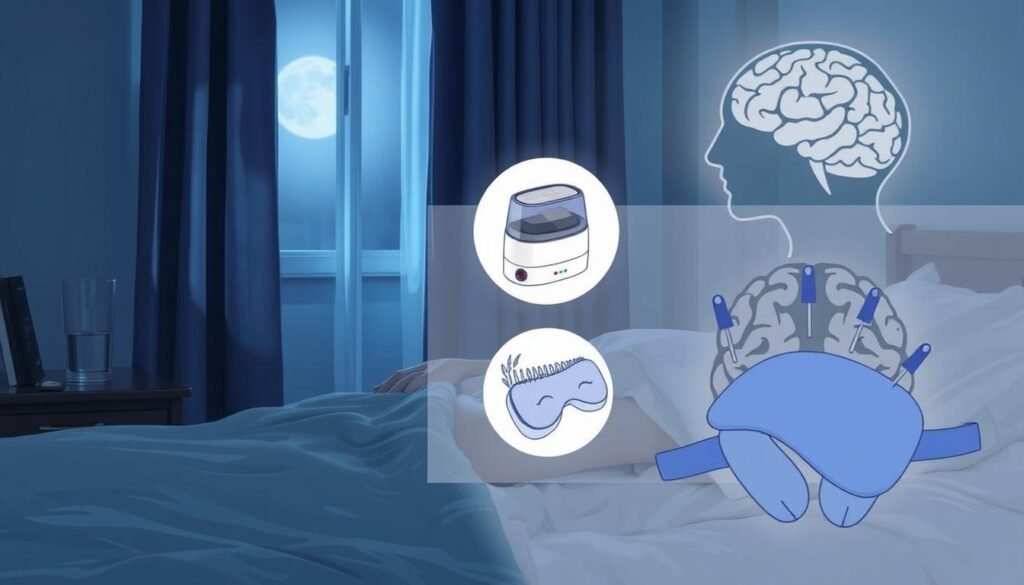
Prevention centers on reducing the triggers that disrupt slow-wave sleep architecture.
Prevention centers on reducing the triggers that disrupt slow-wave sleep. For most people — especially children — lifestyle changes alone reduce episodes significantly. For adults with frequent or dangerous episodes, clinical interventions are available.
How Does Improving Sleep Hygiene Reduce Sleepwalking Episodes?
Sleep hygiene refers to habits and practices that support consistent, quality sleep. Improved sleep hygiene reduces sleepwalking by stabilizing sleep architecture and reducing slow-wave sleep pressure — the driver of sleepwalking episodes. Our full sleep hygiene 101 guide covers every step in detail.
Key sleep hygiene steps for sleepwalking prevention:
- Set a fixed bedtime and wake time — seven days a week, including weekends
- Keep the bedroom cool and dark — ideal sleep temperature is 16–18°C (60–65°F)
- Avoid screens for 60 minutes before bed — blue light delays melatonin release
- Limit caffeine after 2 PM — caffeine has a 5–6 hour half-life in the body
- Avoid large meals within 3 hours of bedtime — digestion disrupts sleep depth
Consistent sleep timing is the single most effective lifestyle change for reducing sleepwalking frequency.
Which Scheduled Awakening Technique Helps Prevent Sleepwalking?
The Scheduled Awakening Technique is a clinically validated method used primarily in children. Here is the full clinical protocol:
- Parents keep a written log of sleepwalking episodes for 1–2 weeks, noting the exact time each episode begins
- Identify the typical episode onset time from the log
- Set an alarm to wake the child 15–30 minutes before that typical time
- Wake the child gently — enough for them to open their eyes and respond briefly
- Allow the child to return to sleep immediately
- Repeat nightly for 2–4 weeks, then taper gradually
This technique works by disrupting the sleep cycle at the exact point of vulnerability — just before the arousal that causes sleepwalking. Studies cited by the AASM report that Scheduled Awakening reduces episode frequency by over 80% in children with predictable episode timing.
How Does Managing Stress and Anxiety Lower Sleepwalking Frequency?
Stress and anxiety increase overnight arousal signals in the brain. Reducing stress lowers those signals — and decreases the chance of partial arousal during slow-wave sleep.
Practical stress reduction strategies that directly support sleep:
- Progressive muscle relaxation before bed (10 minutes)
- Diaphragmatic breathing exercises (4-7-8 breathing method)
- Journaling for 10 minutes to process the day's concerns before sleep
- Regular aerobic exercise (at least 150 minutes per week, but not within 3 hours of bedtime)
- Limiting news and social media in the 90 minutes before sleep
For adults with sleepwalking linked to PTSD or clinical anxiety, stress management alone is rarely sufficient. Clinical treatment is needed alongside these strategies.
Can Cognitive Behavioral Therapy Treat Adult Sleepwalking?
CBT-I (Cognitive Behavioral Therapy for Insomnia) addresses the thought patterns and behaviors that disrupt sleep. For sleepwalking in adults, CBT-I works by improving overall sleep architecture — reducing the fragmented slow-wave sleep that enables sleepwalking.
CBT-I does not target sleepwalking directly. Instead, it treats the underlying sleep quality issues that make sleepwalking more likely. Therapists trained in CBT-I use techniques including sleep restriction, stimulus control, and cognitive restructuring.
The AASM recommends CBT-I as a first-line treatment for chronic insomnia — and its benefits extend to reducing parasomnia frequency in adults.
Which Medications Are Prescribed to Reduce Sleepwalking Episodes?
When behavioral strategies do not control sleepwalking, doctors may prescribe medication. Two main options are used:
| Medication | Type | Best For | Key Concern |
|---|---|---|---|
| Clonazepam | Benzodiazepine | Adults with chronic sleepwalking | Dependency risk with long-term use |
| Melatonin | Hormone supplement | Children; mild adult cases | Minimal — preferred first-line option |
| Zolpidem | Sedative-hypnotic | NOT recommended for sleepwalkers | FDA black box warning; can cause sleepwalking |
Doctors do not prescribe Zolpidem for sleepwalking — it is one of its documented causes.
How Should Parents Modify a Child's Environment to Prevent Injury?
Environmental modification does not prevent sleepwalking episodes — but it prevents injury when they occur. This is the first safety step parents should take after the first episode.
- Install safety gates at the top of every staircase
- Lock exterior doors with a deadbolt placed above a child's reach
- Remove trip hazards from the bedroom floor (toys, shoes, cables)
- Place the mattress directly on the floor if the child sleeps in a loft or raised bed
- Lock windows that a child could open from inside
How Do You Keep a Sleepwalker Safe?
Safety during an episode requires both environmental preparation and caregiver behavior. The goal is to guide the sleepwalker back to safety without triggering fear or resistance.
What Should You Do If You Find Someone Sleepwalking?
- Stay calm. Do not shout or grab the person abruptly
- Assess for danger. Is the person near stairs, a door, or a kitchen?
- Gently guide the person back toward the bedroom using soft verbal cues: "Come this way"
- Do not forcibly restrain the person — this can cause panic or aggression, as the motor cortex is active even though judgment is absent
- Wake the person only if they are in immediate danger. Disorientation will follow but resolves within minutes
- Note the time and duration of the episode in a written log — this information is essential for the Scheduled Awakening Technique
How Should a Bedroom Be Modified to Prevent Sleepwalking Injuries?
The bedroom is where sleepwalking starts — and where most injuries happen. Modify the space before the next episode occurs.
- Clear all floor clutter — shoes, bags, charging cables, and toys
- Pad sharp furniture corners — coffee table edges, bed frames, dresser corners
- Use a low bed frame or floor mattress — reduces fall height
- Add motion-sensor night lights — illuminates the path without waking the person
- Place a door chime or alarm on the bedroom door — alerts others when the sleepwalker leaves the room
Which Safety Devices Help Protect a Sleepwalker at Night?
Several safety devices protect against sleepwalking-related injury:
- Door alarm sensors — emit an alert when a door opens at night
- Bed exit alarms — placed under the mattress; alert when the sleepwalker gets up
- Window locks with key overrides — prevent opening from inside without a key
- Stair gates (adult-rated) — pressure-mounted gates rated for adult weight at stairway entrances
- GPS tracking devices — for adults with episodes involving leaving the home; worn as a wristband
For children with frequent nighttime wandering, a simple door bell alarm on the bedroom door is the most cost-effective first step.
Common Myths About Sleepwalking
Several widely repeated beliefs about sleepwalking are factually wrong. These myths affect how caregivers respond to episodes — sometimes making the situation less safe.
Is It True You Should Never Wake a Sleepwalker?
"Waking a sleepwalker causes physical harm or severe psychological shock."
False. Waking a sleepwalker causes brief confusion and disorientation — lasting a few minutes — as the prefrontal cortex reactivates. This disorientation is harmless. A sleepwalker near a staircase or kitchen should be woken immediately if gentle redirection fails. No clinical evidence supports the idea that waking a sleepwalker causes harm.
Does Sleepwalking Mean a Person Is Acting Out Their Dreams?
"Sleepwalkers are physically acting out their dreams."
No. Sleepwalking occurs during NREM slow-wave sleep — a stage in which dreaming does not occur. REM Sleep Behavior Disorder (RBD) is the separate condition where people physically act out vivid dreams. RBD occurs during REM sleep and is more common in older adults. Confusing the two leads to incorrect treatment. RBD also carries an association with neurodegenerative diseases — making correct diagnosis important.
Can Sleepwalkers See and Navigate Their Environment?
"Sleepwalkers can see clearly and know exactly where they are going."
Partially. Sleepwalkers' eyes are open — but visual processing is limited. The prefrontal cortex, which processes complex spatial reasoning and hazard recognition, remains in deep sleep. Sleepwalkers can navigate familiar environments in a basic way — walking down a known hallway — but they cannot assess danger, read text, or respond accurately to unfamiliar obstacles. They operate on learned motor patterns — not conscious awareness.
When Does Sleepwalking Require Medical Treatment?
Most childhood sleepwalking resolves without treatment. Adult sleepwalking that is frequent, dangerous, or connected to other conditions requires clinical intervention.
What Treatment Options Exist for Chronic Sleepwalking in Adults?
For adults with chronic sleepwalking — defined as episodes occurring more than twice per week or causing injury — the following treatments are used:
Behavioral treatments (first line):
- CBT-I to improve sleep architecture
- Scheduled Awakening (adapted from the pediatric protocol)
- Stress management and anxiety treatment
Pharmacological treatments (second line):
- Low-dose Clonazepam (0.5–2 mg at bedtime)
- Melatonin (1–3 mg, 60 minutes before bed)
Emerging treatments: A 2007 study by Linden et al., published in the International Journal of Clinical and Experimental Hypnosis, found hypnotherapy effective in reducing sleepwalking frequency in adults. Effect sizes were modest but statistically significant. Hypnotherapy remains an adjunct option rather than a primary treatment.
A doctor will assess the cause of sleepwalking before selecting a treatment approach. If medications are the cause, stopping or replacing the medication is the first step.
Does Childhood Sleepwalking Resolve Without Treatment?
Yes — in most cases. The majority of children outgrow sleepwalking by mid-adolescence, as the proportion of slow-wave sleep naturally decreases with age. The AASM confirms that childhood sleepwalking is self-limiting in most cases.
Treatment is only needed when episodes are frequent (more than 2–3 times weekly), involve injury, or persist past age 13–14 without reduction. Parents should focus on safety modification and sleep hygiene rather than expecting medical intervention for typical childhood cases.
How Is Sleepwalking Treated When Linked to Sleep Apnea or PTSD?
When sleepwalking is secondary to another condition, treating that condition directly reduces sleepwalking.
Sleep Apnea + Sleepwalking: CPAP therapy — Continuous Positive Airway Pressure, a machine that keeps the airway open during sleep — eliminates the micro-arousals that trigger sleepwalking. Research published in Sleep Medicine confirmed that consistent CPAP use reduced sleepwalking frequency significantly in adults with comorbid OSA.
PTSD + Sleepwalking: PTSD treatment, including trauma-focused CBT, Image Rehearsal Therapy (IRT), and prazosin (a medication that reduces nighttime PTSD arousal), reduces the overall sleep fragmentation that enables sleepwalking. Sleep medicine specialists and psychiatrists often work together on these cases.
Addressing the root condition is more effective than treating sleepwalking in isolation. Our article on sleep paralysis causes and mechanisms explains how similar arousal disruptions affect different sleep stages.
When to see a doctor — checklist:
- Sleepwalking occurs more than twice per week
- An injury has occurred during an episode
- A child has not outgrown sleepwalking by age 14
- An adult develops sleepwalking with no childhood history
- Sleepwalking began after starting a new medication
- Episodes involve leaving the bedroom or building
- The sleepwalker shows signs of sleep apnea (snoring, gasping)
- The person has PTSD, depression, or an anxiety disorder
Frequently Asked Questions
Yes. Adult-onset sleepwalking most often signals a new trigger — a new medication, untreated sleep apnea, elevated stress, or a psychiatric condition like PTSD. Adult-onset sleepwalking with no obvious trigger warrants a medical evaluation, including a sleep study, to identify the underlying cause. Doctors will screen for OSA, psychiatric conditions, and medication side effects first.
Sleepwalking every night is rare but documented. Nightly episodes typically indicate a strong contributing factor — severe sleep apnea, a medication side effect, or extreme ongoing sleep deprivation. This frequency level requires prompt medical evaluation. Nightly episodes significantly increase injury risk and should not be managed with home strategies alone. A polysomnography study is needed to identify the driving mechanism.
Sleep-related eating disorder (SRED) is a specific parasomnia where a person eats while asleep. It shares the same NREM arousal mechanism as sleepwalking and is classified within the same category. Zolpidem is a documented trigger of SRED. A sleep medicine specialist can distinguish between SRED and classic sleepwalking through polysomnography and a detailed medication review.
Sleepwalking during daytime naps is possible but uncommon. It is more likely if the nap is long enough for the child to enter deep slow-wave sleep — typically after 20–30 minutes. Short naps (under 20 minutes) rarely trigger sleepwalking because they do not reach Stage 3 NREM depth. Parents should monitor for nap-time episodes if nighttime sleepwalking is already present.
Low-dose melatonin (0.5–1 mg, taken 60 minutes before bed) is generally considered safe for short-term use in children. It supports regular sleep timing without suppressing natural sleep architecture. Parents should consult a pediatrician before starting melatonin, as long-term data in children remains limited. Melatonin works best when combined with consistent sleep schedules and sleep hygiene improvements.
Sleep talking (somniloquy) and sleepwalking share the same NREM arousal mechanism. Both occur during partial brain activation in slow-wave sleep. Sleep talking frequently occurs during sleepwalking episodes — the sleepwalker may speak incoherently or respond to questions with confused answers. Shared triggers include sleep deprivation, stress, and fever. People with one NREM parasomnia are at higher risk for others.
📋 Summary: Sleepwalking Causes, Risk, and Prevention
Sleepwalking (ICD-10: F51.3) is a parasomnia that occurs during Stage 3 NREM slow-wave sleep, when thalamo-cortical dissociation causes the motor cortex to activate while the prefrontal cortex stays asleep.
The main causes are sleep deprivation, genetic predisposition, fever, certain medications (including Zolpidem — subject to an FDA April 2019 black box warning), alcohol, stress, and sleep apnea.
Children aged 4–8 face the highest prevalence — up to 30% will sleepwalk at least once. Adults with a family history face a 45–60% inherited risk.
Prevention centers on consistent sleep hygiene, the clinical Scheduled Awakening Technique, stress management, and — when needed — low-dose Clonazepam or Melatonin under medical supervision. Sleepwalking is manageable. Most children outgrow it. Adults with frequent or dangerous episodes have effective treatment options available in 2026.
📚 Further Reading
- American Academy of Sleep Medicine (AASM) — Official diagnostic criteria for parasomnias and sleepwalking disorder.
- Sleep Foundation: Sleepwalking — Consumer-facing overview of sleepwalking causes and treatment options.
- FDA Safety Communication: Complex Sleep Behaviors (April 2019) — The full text of the black box warning for sedative-hypnotic medications.
- NIH National Heart, Lung, and Blood Institute: Sleep Studies — Overview of polysomnography and sleep stage science.
- Narcolepsy Explained — Understand another serious sleep disorder and how it differs from sleepwalking.
- Sleep Cycle Science — The full science behind NREM and REM sleep stages.
- Snoring Causes and Solutions — Snoring signals sleep apnea — a direct sleepwalking trigger.