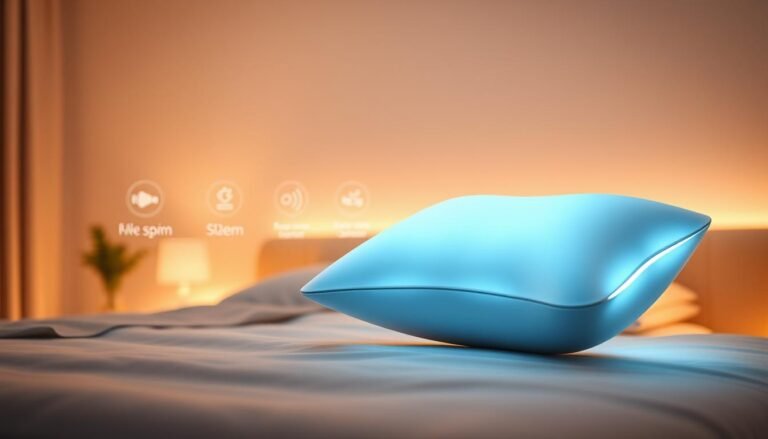
Quick Answer: Smart pillows can track sleep or nudge you off your back, but they cannot diagnose sleep problems. The American Academy of Sleep Medicine says consumer sleep technology lacks validation and FDA clearance for that. We found no controlled trial of a smart pillow, and one small pilot study showed benefit only in mild to moderate apnea.
Before paying for technology, get the support right. The pillow height calculator suggests a loft for your sleep position and shoulder width.
What Is A Smart Pillow?
A smart pillow is a pillow with electronics added, usually linked to a phone app. The term covers quite different products:
| Type | What It Does | Main Limit |
|---|---|---|
| Sleep tracking pillow | Sensors record movement, sound or time in bed and show a score | Estimates, not a sleep study |
| Audio pillow | Built-in speakers play white noise, music or podcasts | Same benefit as a bedside speaker |
| Anti-snore pillow | Detects snoring and shifts your head or prompts you to turn | Little product-specific evidence |
| Cooling pillow | Fans, gels or circulating water keep the surface cool | Comfort feature, not treatment |
Do Smart Pillows Track Sleep Accurately?
Not well enough to rely on for health decisions. The American Academy of Sleep Medicine (AASM) defines consumer sleep technology as widespread applications and devices that purport to measure and even improve sleep. It notes they lack validation against polysomnography, the overnight lab sleep study, which it calls the gold standard (AASM position statement).
Because they lack validation and FDA clearance, the AASM says these devices cannot be used to diagnose or treat sleep disorders at this time. It adds that they may help the patient and clinician talk when presented within a proper clinical evaluation. Treat a pillow sleep score as a rough trend.
If checking your score makes you anxious, see sleep tracking and insomnia.
For the wider picture, read are sleep trackers accurate.
Can A Smart Pillow Stop Snoring?
It may help some people, but the evidence is thin. A 2024 systematic review looked at devices that change head position, including anti-snoring pillows. It found nine studies with 235 patients, and only 50 were simple snorers (Moffa et al. 2024). The authors say these positional methods can be considered reliable options for improving snoring.
They also give strong limits. There are only very few short-term studies, and the authors call for dedicated controlled trials. The devices can be uncomfortable in some sleeping positions, and some people cannot tolerate prolonged head elevation. The review covers positional devices in general and does not single out electronic smart pillows.
How Does Head Position Affect Snoring?
Snoring is common. The review says about 45% of adults snore occasionally and 25% snore regularly (Moffa et al. 2024). Positional therapy devices aim to keep your head and neck aligned so the airway stays open. Another approach, raising the head of the bed, aims to reduce upper airway collapse by lifting the head and trunk.
The review reports that both methods reduced snoring in studies, by increasing the cross-sectional area of the airway and lowering its closing pressure. That is the idea behind an anti-snore pillow. It is also why simple side sleeping can help, which costs nothing to try first.
What Did The One Smart Pillow Study Find?
We found one published study of a smart anti-snore pillow in people with obstructive sleep apnea (Chung et al. 2021). It was a pilot: prospective, non-controlled and non-randomized. Thirty patients, aged 33 to 82, slept one night with the pillow during a sleep study. Twenty-three had mild to moderate sleep apnea, and seven had severe.
In the mild to moderate group, the apnea-hypopnea index (AHI) fell from 14.8 to 10.3 events an hour. The snore count and snore index also fell. In the severe group, there was no significant improvement. The AHI is the number of breathing pauses and slowdowns an hour.
The study had real limits. The authors point to the small number of patients. They also note that one night of testing might cause first-night effect bias, and that AHI and use were not followed long term. There was no control group, and a company supported the study. So it suggests the idea is worth testing. It does not prove a smart pillow treats sleep apnea.
Are Smart Pillows Medical Devices?
The AASM statement says consumer sleep technology lacks FDA clearance for diagnosis or treatment. We found no FDA statement about smart pillows specifically. So if a pillow claims to treat snoring or sleep apnea, check what the claim is and who made it. Also check whether the product has been cleared for that use.
Smart Pillow vs Regular Pillow: Which Is Better?
| Smart Pillow | Regular Pillow | |
|---|---|---|
| Neck support | Depends on the pillow under the electronics | Depends on height, fill and firmness |
| Sleep data | Estimates from sensors | None |
| Extras | Audio, cooling, position nudges | None |
| Cleaning | Electronics may limit washing | Usually washable or has a washable cover |
| Things that can fail | Battery, pump, sensors, app support | Fill flattening over time |
| Cost | Usually much higher | Wide range |
For most people, a well-fitted regular pillow does the main job, keeping the neck in line with the spine. That is also the one thing no sensor can do for you, so fit comes first. Your mattress matters too. The mattress calculator matches firmness to your position and weight.
Can A Smart Pillow Help With Insomnia?
Probably not much on its own. Insomnia is usually kept going by habits, worry about sleep and an irregular schedule. A pillow does not change those. Audio features may help some people relax at bedtime, in the same way as any calming routine.
Sleep scores can backfire if a poor score makes you worry more about the next night. For approaches that help long-term insomnia, see our guide to beating insomnia.
What About Your Data And Privacy?
A pillow that records sound or movement in your bedroom collects personal data, and that data may be stored on a company server. Before you set one up, read what the app stores and whether recordings leave your phone. Check whether you can switch features off or delete your history. If a device needs an account, use a strong, unique password.
What Should You Check Before Buying One?
- The pillow itself: height, firmness and shape for your sleep position.
- Claims: wellness wording versus a claim to treat a condition, and who tested it.
- Evidence: an independent study of that exact product, not only the maker’s page.
- Power and noise: battery life, charging, and any noise from pumps or fans.
- Cleaning: a removable, washable cover.
- Data: what the app collects and whether you can delete it.
- Returns and warranty, since comfort is personal and electronics can fail.
Who Might Find A Smart Pillow Useful?
- People who like a sound machine but share a bed and want audio only on their side.
- Back sleepers whose simple snoring improves when they sleep on their side, and who have been checked for sleep apnea.
- People who enjoy tracking trends and will not be worried by a low score.
A smart pillow is a poor choice if you are hoping it will fix insomnia, neck pain from a badly fitted pillow, or untreated sleep apnea. For snoring in general, read snoring causes and solutions.
See a doctor if: you snore loudly most nights or someone has seen you stop breathing or gasp in your sleep. Also go if you are sleepy by day despite enough time in bed, or have neck or shoulder pain that lasts or spreads. These need a proper assessment, not a gadget. A home sleep apnea test or a visit to a sleep specialist is the next step.
FAQs About Smart Pillows
Do Smart Pillows Really Work?
For extras like audio and cooling, yes. For tracking, they give estimates, and for snoring the evidence is small. We found no controlled trial of a smart pillow.
Can A Smart Pillow Detect Sleep Apnea?
No. The AASM says consumer sleep technology cannot be used to diagnose sleep disorders. A sleep study is needed.
Is A Smart Pillow Better For Neck Pain?
Not by itself. Neck comfort depends on pillow height and firmness for your sleep position, which a regular pillow can match.
Are Anti-Snore Pillows Worth It?
They may help some people who snore on their backs, but the evidence is limited. Try side sleeping and a fitted pillow first, and get checked if you might have sleep apnea.
Is Snoring Always A Sign Of Sleep Apnea?
No. The 2024 review notes that snoring is a common symptom of obstructive sleep apnea, but not everyone who snores has it. Loud snoring with pauses in breathing needs a check.
What Is The Best Alternative To A Smart Pillow?
A well-fitted pillow, a supportive mattress, side sleeping if you snore on your back, and a sleep test if you might have sleep apnea.
Your Next Step
Enter your sleep position and shoulder width to get a suggested loft before you pay for extras.