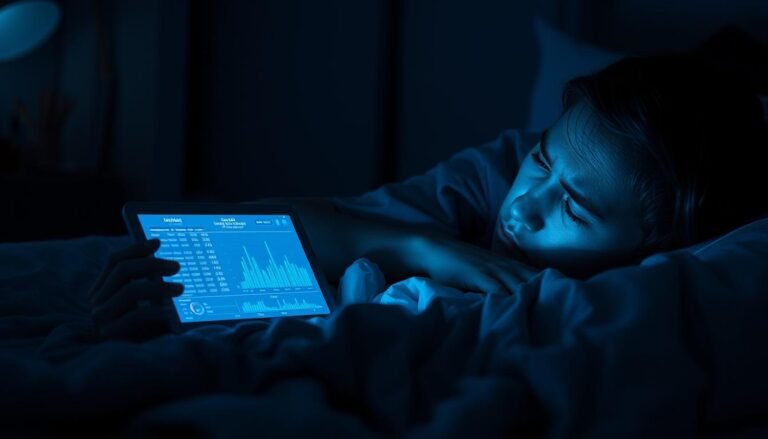
For some people, yes. Sleep trackers do not cause insomnia, but when the nightly score becomes something to chase or fear, it can add worry and effort to sleep and make existing insomnia harder to shake. Sleep clinicians use the word orthosomnia for this: a preoccupation with getting perfect sleep data. It was described in patients who sought treatment for sleep problems they had spotted on their tracker, and who often felt the tracker was more accurate than a sleep lab test (Baron et al., 2017). It is not a formal diagnosis, and research on it is still limited (Sleep Foundation).
Not medical advice. This guide summarizes published research and health agency information for general education. It cannot tell you whether your sleep is normal or whether you have a sleep disorder. If you are worried about your sleep, talk to a doctor.
What Is Orthosomnia?
Orthosomnia is the proposed term for an obsessive pursuit of optimal sleep that is driven by sleep tracker data. It is not a recognized medical disorder, and there is no standard list of symptoms. It can occur alongside insomnia and other sleep disorders and may persist even after a primary sleep disorder has been treated (Sleep Foundation).
The original report described patients who came to clinics about insufficient sleep or insomnia based on periods of light or restless sleep on their tracker. The authors suggest that trackers be built into cognitive behavioral therapy for insomnia (CBT-I) (Baron et al., 2017). In the early case reports, people stayed in bed too long to improve their tracker numbers, which may have worsened their insomnia (Sleep Foundation).
How common is it? One cross-sectional survey of 523 adults found that 35.8 percent regularly used a sleep-tracking device. A screening algorithm estimated orthosomnia in 3.0 to 14.0 percent of the sample, depending on how strict the cut-offs were, and those people had more severe insomnia symptoms. The authors note that a cross-sectional design has limits (Jahrami et al., 2024).
How Consumer Sleep Trackers Work
Wearables use sensors, usually movement plus heart rate, and algorithms to estimate when you are asleep. Many now report total sleep time, time in sleep stages, a sleep score and heart rate or breathing during sleep (Sleep Foundation). Proprietary algorithms and firmware updates matter when judging a device, and little guidance exists on how to use the data (de Zambotti et al., 2019).
The gold standard for measuring sleep is polysomnography (PSG), a lab test (Chinoy et al., 2021). Tracker readings are estimates, and the FDA does not regulate sleep trackers (Sleep Foundation).
How Accurate Are Sleep Trackers Compared With Sleep Lab Tests?
Accurate enough to be useful for some things, and unreliable for others. The main findings from the research:
- Detecting sleep is good. In a lab study of 34 healthy young adults, seven consumer devices were tested against PSG. Most matched or beat a research actigraph at sleep and wake detection, and sensitivity (the share of sleep correctly identified) was 0.93 or above (Chinoy et al., 2021).
- Detecting wake is weak. In the same study, specificity (the share of wake correctly identified) was low to medium, at 0.18 to 0.54. In plain terms, devices tend to read some wakefulness as sleep (Chinoy et al., 2021).
- Sleep stages are inconsistent. Stage comparisons were mixed, and devices tended to perform worse on nights of poorer or disrupted sleep (Chinoy et al., 2021).
- Insomnia is a harder test case. In 25 adults with insomnia disorder, a consumer wrist tracker gave estimates similar to a research-grade actigraph. The authors still advised caution (Hamill et al., 2020).
- Experts call for care, not rejection. A review of wearables concluded the technology holds promise but needs a careful path forward (de Zambotti et al., 2019). A 2025 World Sleep Society task force separates fundamental sleep measures from proprietary exploratory metrics and covers use in people with insomnia (Chee et al., 2025).
The Sleep Foundation sums it up: trackers can roughly estimate total sleep time, but even newer devices were only moderately successful at determining sleep stages. Smartphone-only apps are considered inaccurate and ineffective (Sleep Foundation).
What Trackers Do Well And What They Do Badly
Match each number to how much it deserves your trust. The reliability column is our plain-language reading of the studies above, not a measurement of any specific device.
| Metric | How reliable it is | How to use it |
|---|---|---|
| Total sleep time | Roughly accurate overall, with some error; worse on disrupted nights (Chinoy 2021) | Look at the weekly average and trend, not one night |
| Bedtime and wake time | Detecting sleep versus wake is a relative strength (high sleep sensitivity) | Check how regular your timing is. Our sleep consistency calculator can score it |
| Awake time during the night | Weak. Some wake is read as sleep (Chinoy 2021) | Do not assume you slept through the night; compare with how you felt |
| Sleep stages (light, deep, REM) | Inconsistent against PSG (Chinoy 2021) | Treat as rough estimates, not a diagnosis; do not chase a number |
| Sleep score | Built from the maker’s own algorithm, so not comparable between brands (de Zambotti 2019) | Use only as a conversation starter, not a verdict on your night |
| Heart rate variability and other extra metrics | Proprietary and exploratory (Chee 2025) | Ignore if they make you anxious; they do not diagnose anything |
Why Tracking Can Backfire: Sleep Effort And Performance Anxiety
Sleep is an involuntary physiological process that cannot be placed under full voluntary control, so direct attempts to control it may make insomnia worse. Researchers who developed the Glasgow Sleep Effort Scale described the striving to control sleep as a frequent clinical observation in people with insomnia (Broomfield and Espie, 2005). A tracker can turn that into a daily test, with a grade each morning to beat tomorrow.
Sleep experts name several ways this can go wrong (Sleep Foundation):
- Overtrusting imprecise data, which can lead you to misjudge how well you are actually sleeping.
- Misplaced goals, such as lying still in bed longer, which can improve the data even if you are awake.
- Distrust of formal sleep studies, which specialists consider the most accurate.
Worrying about whether you will get enough sleep and watching the clock can raise your risk of insomnia or make it worse (NHLBI). If worry at bedtime already feels familiar, our guide to insomnia vs anxiety explains how the two feed each other.
When Tracking Helps
Tracking is not the problem; fixating on it is. Recording sleep is a standard part of insomnia care:
- NHLBI suggests keeping a sleep diary for 1 to 2 weeks before seeing your doctor, noting sleep, wake and nap times, daytime sleepiness, caffeine, alcohol and exercise (NHLBI).
- The AASM says a sleep diary helps you understand your sleep pattern and can reveal causes such as late caffeine or naps. It adds that many apps and sleep trackers include a sleep diary (AASM Sleep Education).
- In CBT-I, sleep restriction starts by calculating your typical time asleep from a sleep diary, and homework often includes keeping one (Sleep Foundation). CBT-I is usually recommended as the first treatment for long-term insomnia (NHLBI).
Not sure how much your sleep is affecting you? The insomnia severity calculator scores your symptoms from how you feel, no device needed.
How To Use A Sleep Tracker Without Obsessing
No trial has tested a rulebook for this. The steps below come from the sources cited, apart from the one marked as our own inference, and are practical suggestions rather than a proven program.
- Remember the data is imperfect. Do not treat the score or stage breakdown as a verdict. A doctor or sleep specialist can give context, especially if you have sleep problems or daytime drowsiness (Sleep Foundation).
- Judge your sleep by how you feel and function by day, not just the number. Insomnia involves daytime symptoms, not only a nightly figure (AASM).
- Do not extend time in bed to improve your data. That is the pattern described in orthosomnia reports (Sleep Foundation), and spending extra time in bed to force sleep makes falling asleep harder (Sleep Foundation).
- Do not clock-watch. Since watching the clock can make insomnia worse (NHLBI), it is reasonable, as our own inference, to avoid checking the tracker during the night.
- Track for a purpose and a limited time. A 1 to 2 week window, as for a sleep diary, is enough to show a pattern for a doctor (NHLBI).
- Focus on the habits you control: a regular sleep schedule, winding down before bed and keeping electronics out of the bedroom (Sleep Foundation), and the same wake time every day (AASM).
- Take a break if it adds stress. If checking the data leaves you anxious, share your concerns with your doctor (Sleep Foundation). A paper sleep diary does a similar job without a score.
When To See A Doctor
- You have trouble falling or staying asleep 3 or more nights a week for 3 months or longer, which is how chronic insomnia is defined (NHLBI).
- You feel tired, unrefreshed or unable to concentrate in the daytime, or you are worried or frustrated about your sleep (AASM).
- Your tracker data is causing worry, or you notice yourself staying in bed or checking the app to improve numbers. Share your concerns with your doctor (Sleep Foundation).
- You snore loudly, wake up gasping or have other symptoms of a sleep disorder that a tracker may not detect. A doctor can decide whether further testing is needed (NHLBI).
Start with your regular doctor. For chronic insomnia, a sleep doctor at an accredited sleep center can help, and the AASM recommends CBT-I as a treatment for chronic insomnia in adults (AASM).
Honest Limits Of This Guide
Most validation studies test healthy young adults on a few nights in a lab, so they may not match your sleep at home (Chinoy et al., 2021). Results for one device do not carry over to another. The orthosomnia research is limited, so it does not prove that trackers cause insomnia. We did not test any device ourselves.
For related reading on sleep gadgets, see our review of whether smart pillows work.
Sleep Tracking And Insomnia FAQs
Can Sleep Trackers Make Insomnia Worse?
They can for some people. Researchers describe orthosomnia, a preoccupation with perfect sleep data that can add stress and effort around sleep.
Are Sleep Trackers Accurate?
Fairly good at detecting sleep, weaker at detecting wake, and inconsistent with sleep stages compared with lab polysomnography.
What Is Orthosomnia?
It is the proposed term for an obsessive pursuit of ideal sleep driven by tracker data.
Should I Stop Tracking My Sleep If I Have Insomnia?
Not necessarily. If checking the numbers makes you more anxious, pause it and talk to your doctor.
Is A Sleep Diary Better Than A Tracker For Insomnia?
A sleep diary is the standard tool in insomnia care and records habits and how you felt.
Can A Tracker Diagnose A Sleep Disorder?
No. Consumer trackers are not regulated by the FDA and cannot replace a doctor’s evaluation.