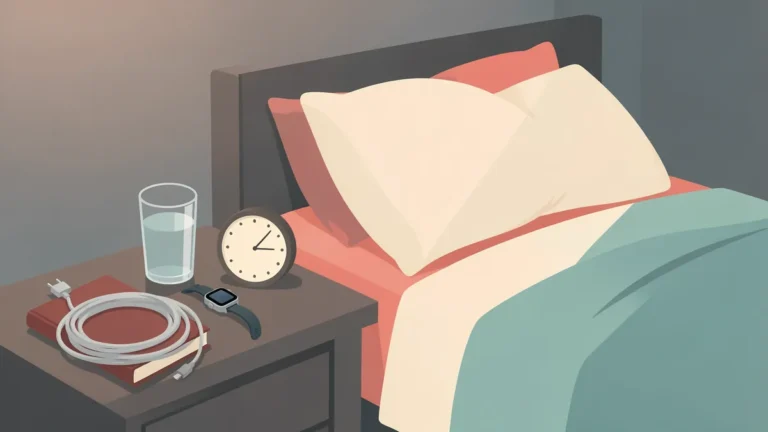
Yes, an Apple Watch can track sleep. It estimates how long you slept and when you woke, and it shows sleep stages and a sleep score. The time-asleep estimate is reasonably good. The stage estimates are much less reliable. Apple says sleep tracking uses your motion to detect sleep (Apple Support), and independent studies find it usually overestimates sleep and mixes up deep and light sleep. This guide covers the setup, what it measures, how the score works, how accurate it is and how to use it well. It is for education only.
Want to check your own numbers by hand? Use how to calculate hours of sleep.
Apple Watch Sleep Tracking Setup
Apple lists a short set of steps and requirements (Apple Support):
- Update your iPhone and your watch to the latest software.
- Open the Health app, tap Get Started under Set Up Sleep, and set a sleep goal, bedtime and wake time.
- Turn on Track Sleep with Apple Watch.
- Charge the watch to at least 30 percent before bed. If the battery dies, it will not track your sleep.
- Wear it to sleep for at least 1 hour so it has enough data.
Fit matters too. A loose band may let the accelerometer record movement during natural sleep, so Apple suggests a snug but comfortable fit (Apple Support).
What An Apple Watch Measures During Sleep
According to Apple, it tracks time asleep against your goal, and sleep stages named Awake, REM, Core and Deep. It also shows your heart rate and breathing rate during sleep, and on Series 8 and later and all Ultra models, changes in wrist temperature overnight (Apple Support). Apple’s name “Core” roughly matches light sleep. You can read about the real stages in what is deep sleep and what is REM sleep.
Apple Watch Sleep Score: What It Counts
The Sleep Score runs from 0 to 100 each morning. Apple says it is based on three parts (Apple Support):
| Component | Points | What It Looks At |
|---|---|---|
| Duration | 50 | Your estimated time asleep |
| Bedtime consistency | 30 | When you fell asleep over the last 13 nights |
| Interruptions | 20 | How often you woke and for how long |
The bands are Very Low 0 to 40, Low 41 to 60, OK 61 to 80, High 81 to 95 and Very High 96 and above (Apple Support). Notice that half the score is duration and 30 points reward a regular bedtime. That fits sleep science. See why sleep regularity matters, and compare with our sleep score calculator.
How Accurate Is Apple Watch Sleep Tracking?
Apple points to its own validation document on its support page, but I could not open that document, so I cannot quote Apple’s figures. Independent research gives a mixed picture.
| Study | Setup | Result for Apple Watch |
|---|---|---|
| Schyvens et al. 2025 | 62 adults, one lab night against a sleep study; 20 Apple Watch Series 8 nights | Detected sleep 96 percent of the time, but identified wake correctly only 52 percent. Overestimated total sleep by about 20 minutes (Schyvens et al. 2025) |
| Lee et al. 2023 | 75 adults, 11 consumer trackers against a sleep study | Apple Watch 8 had the lowest overall accuracy of the wearables tested, with low agreement on deep sleep (Lee et al. 2023) |
| Lambe et al. 2026 | Review of 82 studies and 430,052 people | Sleep and wake detection is good enough for personal monitoring; sleep stage accuracy is poor (Lambe et al. 2026) |
The studies differ in design, so do not compare their numbers directly. The Schyvens study found the Apple Watch had the highest agreement of six wrist devices, but with only 20 Apple nights it is a small sample. The Lee study found it near the bottom of its group. Both agree on the main point: it is better at telling sleep from wake than at naming stages.
Apple Watch Sleep Stages: How Much To Trust Them
In the same lab study, the watch got light sleep right about 83 percent of the time, REM about 69 percent and deep sleep about 51 percent. It underestimated deep sleep by about 25 minutes and overestimated light sleep by about 59 minutes compared with the sleep study (Schyvens et al. 2025). A review adds that deep sleep is often misclassified as light (Lambe et al. 2026). So treat your “Deep” number as a rough guide. For what normal looks like, see deep sleep vs REM sleep and the sleep stage percentage calculator.
Can An Apple Watch Detect Sleep Apnea?
Apple has a sleep apnea notification. Apple says it analyzes breathing disturbances measured by the watch’s accelerometer and is intended to detect signs of moderate to severe sleep apnea in adults 18 and over without a diagnosis. It prompts users to talk to a doctor (Apple). A review of validation data reported a specificity of 98.5 percent and a sensitivity of 66.3 percent in 1,499 people (Lambe et al. 2026), which means it can miss a third of cases. A notification is a prompt to be tested, not a diagnosis. See sleep apnea screening tests.
What Can Make The Data Wrong
- A flat battery. Under 30 percent at bedtime risks a gap (Apple Support).
- A loose strap. It may log movement as wake (Apple Support).
- Lying still and awake. Motion-based tracking tends to count quiet wake as sleep. Studies find wearables overestimate sleep by misclassifying wake (Lee et al. 2023).
- Short sleep. Apple wants at least an hour of wear to track a night (Apple Support).
Is Tracking Good For You? The Orthosomnia Problem
For some people, the numbers cause worry. Sleep doctors described patients who sought treatment because of periods of light or restless sleep on their tracker, and who felt the data matched their experience more than clinical tests. They called the effect a perfectionistic quest for ideal sleep (Baron et al. 2017). Their advice is to use trackers to monitor patterns rather than exact minutes, and to keep a written sleep log alongside. Read can sleep tracking make insomnia worse.
How To Use It Wisely
- Watch trends, not single nights. A week of averages says more than one score.
- Trust sleep time and bedtime regularity more than stages.
- Cross-check with how you feel. How rested you are matters more than the number.
- Keep a simple diary for two weeks if you are worried.
- Do not self-diagnose. The AASM says consumer devices cannot be used to diagnose or treat sleep disorders at this time (AASM position statement).
See also are sleep trackers accurate and average hours of sleep.
Quick Takeaways
- An Apple Watch can track sleep once Track Sleep with Apple Watch is on.
- It is good at telling sleep from wake and poorer at naming stages.
- The Sleep Score is half duration, 30 percent bedtime consistency and 20 percent interruptions.
- Use averages over a week, not single nights.
- It cannot diagnose a sleep disorder.
When To See A Doctor
The CDC advises talking to your healthcare provider if you regularly have problems sleeping or notice signs of a sleep disorder (CDC). That applies even if your watch shows a good score. Loud snoring with breathing pauses, heavy daytime sleepiness or an apnea notification are reasons to ask for a test. For more clues, read signs you have a sleep disorder.
FAQs About Apple Watch Sleep Tracking
Does The Apple Watch Track Sleep Automatically?
Once Track Sleep with Apple Watch is on, it tracks overnight when you wear it, with the watch at least 30 percent charged at bedtime (Apple Support).
Which Apple Watch Models Track Sleep?
Apple’s guide says sleep tracking is available on watchOS 8 or later (Apple Support). Wrist temperature needs a Series 8 or later or an Ultra (Apple Support). Check Apple’s page for your model.
Is The Apple Watch More Accurate Than A Fitbit?
Studies do not give a clear winner. Results depend on the study, model and the metric (Lee et al. 2023, Schyvens et al. 2025).
What Is A Good Sleep Score On Apple Watch?
Apple’s bands are OK at 61 to 80 and High at 81 to 95 (Apple Support).
Can I Rely On Apple Watch Deep Sleep Numbers?
Not closely. Deep sleep is often misclassified as light (Lambe et al. 2026).
Can An Apple Watch Diagnose Sleep Problems?
No. Consumer devices should not replace validated diagnostic tests (AASM position statement).