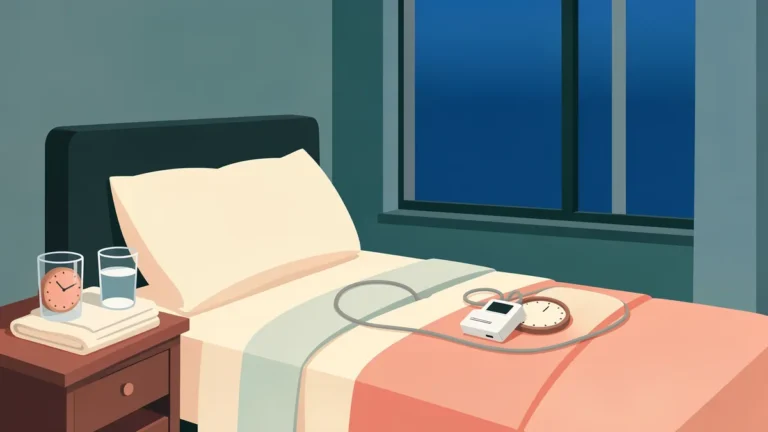
Quick Answer: A home sleep apnea test records breathing, effort and oxygen in your own bed. Trials in people likely to have moderate to severe apnea found home pathways worked as well as lab pathways, with similar symptom outcomes and CPAP use. But a normal or technically poor home test does not rule apnea out: in one clinic, 24 percent of normal tests and 71 percent of poor ones were followed by an apnea diagnosis.
Explore your numbers with our AHI calculator.
What Is A Home Sleep Apnea Test?
It is a portable device you use at home to check for sleep apnea. An AASM task force said that, at a minimum, a portable monitor must record airflow, respiratory effort and blood oxygen, using the same kinds of sensors used in a lab study. It should be run under an accredited sleep program as part of a full sleep evaluation (Collop and colleagues, 2007).
Home tests generally use fewer sensors than a lab study, which is why a lab study is used when more detail is needed. For what happens at a sleep center, read our guide on what happens during a sleep study.
Who Should Not Use A Home Test?
The same task force said portable monitoring is not appropriate for patients with significant medical conditions that may reduce its accuracy, or for those suspected of having other sleep disorders. It is also not appropriate for general screening of people with no symptoms. It may be used when a lab study is not possible, for example because of immobility, safety or critical illness.
These rules come from 2007, and later guidance has updated them. To see how sleep apnea is flagged before a test, read our guide on sleep apnea screening tests.
| Situation | Home test (2007 AASM task force) |
|---|---|
| High chance of moderate to severe apnea | May replace a lab study |
| Serious medical conditions that affect accuracy | Not appropriate |
| Suspected other sleep disorders | Not appropriate |
| Screening people with no symptoms | Not appropriate |
Does Home Testing Work As Well As A Lab Study?
In trials, yes, for the right patients. A trial of veterans with suspected apnea assigned 296 people to home testing or in-lab testing. Of these, 260 (88 percent) were diagnosed and 213 (75 percent) began CPAP. Functional outcome scores improved by 1.74 in the home group and 1.85 in the lab group, and CPAP use was 3.5 versus 2.9 hours a night, which met the noninferiority tests (Kuna and colleagues, 2011).
A Spanish trial of 430 patients with intermediate to high suspicion of apnea found home respiratory polygraphy noninferior to polysomnography on the Epworth sleepiness score, with similar quality of life and blood pressure, and a lower per-patient cost of about 417 euros (Corral and colleagues, 2017).
How Was The Veterans Trial Run?
Veterans with suspected sleep apnea were randomly assigned to home or in-lab testing. Home testing used a type 3 portable monitor, followed by at least three nights on an auto-adjusting pressure device. Everyone diagnosed with sleep apnea was treated with CPAP for 3 months.
The researchers set their noninferiority goals before the trial: a drop of no more than 1 point on the functional outcome score and no more than 0.75 hours a day in CPAP use. The results stayed inside both limits, which is why the authors called the home approach not clinically inferior.
What Was Different About The Spanish Trial?
It ran in 12 tertiary hospitals and followed patients for 6 months. Both groups got the same treatment decisions, CPAP or a healthy habit assessment, auto-adjusting titration, quality-of-life surveys, 24-hour blood pressure monitoring, and a lab sleep study at the end of follow-up. The main outcome was the Epworth Sleepiness Scale.
Noninferiority meant home care could be no worse than 2 points on that scale. The authors concluded that conventional polysomnography is not necessary for most patients with suspected apnea, though the people were screened as having intermediate to high suspicion.
What Did The HomePAP Trial Find?
This US trial gave 373 adults with a high chance of moderate to severe apnea either a home test followed by a week of auto-adjusting CPAP, or a lab study with CPAP titration. After 3 months, CPAP use was 4.7 hours a night in the home group and 3.7 in the lab group. Adherence, meaning nights of 4 hours or more, was 62.8 percent versus 49.4 percent. Acceptance of CPAP, pressures, time to treatment and change in sleepiness did not differ (Rosen and colleagues, 2012).
Only about half of each group remained eligible after testing, because many people had an AHI below 15. The authors concluded the home pathway was not inferior, and that it offers a workable path for diagnosis and treatment when patients are chosen well. Note that the people enrolled were chosen for a high chance of moderate to severe disease. If CPAP follows, see our guide on how to get used to CPAP.
What If A Home Test Is Normal Or Poor?
You may still need a lab study. A clinic reviewed 1,157 patients referred for a home test. Of 238 whose test was normal or technically inadequate and who then had a lab study, 127 had a normal home test and 111 had a technically inadequate one (Zeidler and colleagues, 2015).
After a normal home test, 76 percent had a normal lab study, but 24 percent had sleep apnea (23 mild, 6 moderate, 1 severe). After a technically inadequate test, 71 percent had sleep apnea (43 mild, 19 moderate, 17 severe). People under 50 with a normal home test were more likely to have a normal lab study.
| Home test result | Normal lab study later | Sleep apnea on lab study |
|---|---|---|
| Normal (127 patients) | 76% | 24% |
| Technically inadequate (111) | 29% | 71% |
What Should You Do Before A Home Test?
These are practical suggestions, not medical advice:
- Ask your doctor whether you are a good fit for a home test or need a lab study.
- Follow the setup directions exactly and ask for a demo if you are unsure.
- Tell your provider about heart, lung or nerve conditions and medicines.
- If a test is poor or negative but you still have symptoms, ask about repeating it.
- Book the follow-up visit to review the result.
To learn what the report numbers mean, read our guide on how to read sleep study results.
How Strong Is The Evidence?
Good for the trial populations, narrower beyond them. The home pathway trials enrolled people with a high chance of moderate to severe apnea. The follow-up study was a single clinic review. The 2007 guideline is older, and newer guidance has changed some details. No study here shows that a home test is right for everyone.
When To See A Doctor
Talk to a doctor if you snore loudly, wake gasping, stop breathing in your sleep, feel very sleepy in the day, or fall asleep at unsafe times. A home test is one tool, and a doctor decides which test fits.
If you feel unsafe to drive, do not drive. If you have chest pain or severe trouble breathing, call 911. If you feel hopeless or think about harming yourself, call or text 988 in the US.
FAQs About The Home Sleep Apnea Test
What Does A Home Sleep Apnea Test Measure?
At a minimum, airflow, breathing effort and blood oxygen, according to an AASM task force.
Is A Home Test As Good As A Lab Study?
In trials of people likely to have moderate to severe apnea, home pathways gave similar outcomes and CPAP use. Results may not apply to everyone.
Who Should Not Have A Home Test?
People with significant medical conditions that affect accuracy, or suspected other sleep disorders. It is also not for screening people with no symptoms.
What If My Home Test Is Negative?
You may still have apnea. In one clinic, 24 percent of people with a normal home test had apnea on a later lab study.
What If The Test Fails?
A technically inadequate test was followed by an apnea diagnosis in 71 percent of those who then had a lab study in that clinic.
Does Home Testing Change CPAP Use?
In the HomePAP trial, home-pathway patients used CPAP 4.7 hours a night versus 3.7 hours for the lab pathway.
Is A Home Test Cheaper?
In the Spanish trial, home respiratory polygraphy cost about 417 euros less per patient.
Your Next Step
Get a quick read on which sleep problems may fit your symptoms.
Sources
- Clinical guidelines for the use of unattended portable monitors in the diagnosis of obstructive sleep apnea in adult patients (J Clin Sleep Med, 2007)
- Noninferiority of functional outcome in ambulatory management of obstructive sleep apnea (Am J Respir Crit Care Med, 2011)
- Conventional polysomnography is not necessary for the management of most patients with suspected obstructive sleep apnea: noninferiority, randomized controlled trial (Am J Respir Crit Care Med, 2017)
- A multisite randomized trial of portable sleep studies and positive airway pressure autotitration versus laboratory-based polysomnography: the HomePAP study (Sleep, 2012)
- Predictors of obstructive sleep apnea on polysomnography after a technically inadequate or normal home sleep test (J Clin Sleep Med, 2015)