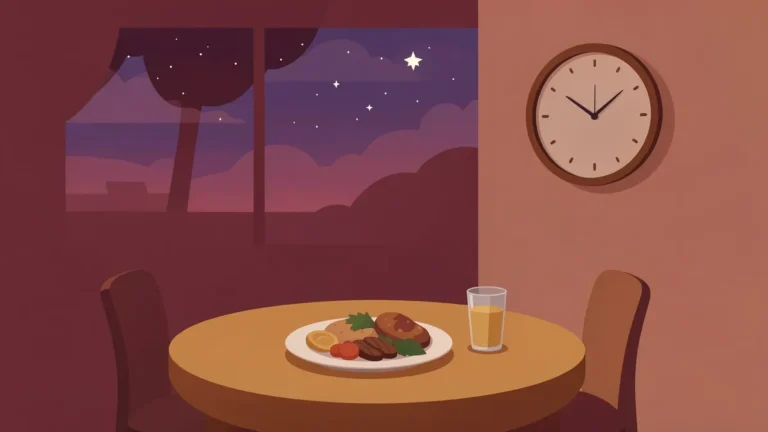
Most experts suggest finishing your last full meal 2 to 4 hours before bed. If you get acid reflux, aim for at least 3 hours before you lie down. A small snack closer to bedtime is usually fine if you are truly hungry (Sleep Foundation, NIDDK).
Planning your evening? The bedtime calculator gives you a bedtime, so you can count back to a dinner cutoff.
The Short Answer On Meal Timing
The Sleep Foundation says most experts recommend eating a meal two to four hours before bed and avoiding full meals inside that window (Sleep Foundation). For people with nighttime reflux, the NIH advises meals at least 3 hours before lying down or going to bed (NIDDK).
The popular 10-3-2-1-0 rule uses a similar 3-hour food cutoff. We found no clinical study behind that exact rule, so treat it as a handy habit, not a tested one. See the 10-3-2-1-0 sleep rule for the full checklist.
Why Timing Matters For Your Body Clock
Your body handles food differently at night. In a lab trial, 20 healthy adults ate dinner at 6 p.m. on one occasion and 10 p.m. on another, with the same bedtime of 11 p.m. After the late dinner, peak blood sugar was about 18 percent higher (150.3 versus 127.0 mg/dL), and the body burned less of the fat in the meal (74.5 versus 84.5 percent) (Gu et al. 2020).
Sleep stages did not change in that trial. But it was a short, small test in young, healthy people, and the authors say long-term effects on weight are unknown (Gu et al. 2020). To see how your own clock shifts, try the circadian rhythm calculator or read circadian rhythm explained.
Late Eating, Hunger And Weight
A Harvard-led crossover study of 16 adults with overweight or obesity ate the same calories on two schedules. When meals ran about 4 hours later, people felt hungrier, had lower levels of the fullness hormone leptin over 24 hours, burned calories more slowly, and showed changes in fat-tissue genes that favor fat storage (Harvard Medical School).
In that study, the early schedule ended at 5 p.m. and the late one at 8:30 p.m. (Harvard Health). The trial did not report sleep results, so it supports the weight and appetite story, not a sleep claim. The group was also small.
Eating Close To Bed And Waking At Night
Large survey data point the same way. Among 124,239 US adults, those who ate or drank within an hour of bed had 2.26 times the odds of lying awake for 30 minutes or more after falling asleep. This is a snapshot from one day of self-reports, so it cannot prove cause (Iao et al. 2022).
The Sleep Foundation reports a similar finding. People who ate or drank less than an hour before bed were much more likely to wake after falling asleep than those who finished two or more hours earlier (Sleep Foundation). Big, rich meals less than an hour before bed can also make it take longer to fall asleep.
The same survey found those people slept about 29 minutes longer overall. So late eating may not shorten your night, but it may make it choppier (Iao et al. 2022).
What The Late Dinner Trial Did Not Show
It is worth reading the fine print. The adults in the dinner trial were healthy and averaged 26 years old. Cortisol, a stress hormone, was slightly higher over 20 hours after the late dinner (11.4 versus 10.8), and sleep stages did not change. People who normally slept earlier had bigger blood sugar jumps after the late meal (Gu et al. 2020).
So the study suggests late dinners are harder on the body, but it does not prove they harm sleep or cause weight gain. Think of it as a reason to shift dinner earlier when you can, not a rule to fear.
Does The Type Of Food Matter?
Yes, a little. The Sleep Foundation says high-calorie meals rich in fat or carbs eaten less than an hour before bed can lengthen the time it takes to fall asleep. High-carb meals eaten at least 4 hours before bed may shorten the time you spend awake in bed (Sleep Foundation).
Late eating can also raise obesity risk, but that depends on the foods and portions. Stress, medicines, exercise and genes matter too (Sleep Foundation). The point is that meal timing is one piece of a bigger picture. Our guide to deep sleep shows other levers.
Reflux: The Strongest Reason To Wait
Lying down right after a meal can push stomach contents up against the valve at the bottom of the food pipe, which can cause reflux (Sleep Foundation). For people with nighttime symptoms, the NIH says meals at least 3 hours before bed may improve symptoms (NIDDK).
The NIH also lists common triggers: citrus, tomatoes, alcohol, chocolate, coffee, high-fat foods, mint and spicy foods. Triggers vary from person to person (NIDDK). Reflux that wakes you often, or that comes with trouble swallowing or chest pain, deserves a doctor visit.
What To Do If You Are Hungry At Bedtime
A light snack can help if you would otherwise go to bed hungry, or if you are prone to low blood sugar overnight. The Sleep Foundation sums it up with a quote from a sleep doctor: less is more when it comes to bedtime snacking (Sleep Foundation).
One small study found that eating two kiwifruits before bed reduced the time to fall asleep. It was a small study, so treat it as a tip to try, not a cure (Sleep Foundation).
Stop and ask whether you are really hungry. The same source notes that hunger can be mistaken for boredom, tiredness or anxiety. For more ideas on sleep-friendly foods, see foods that help you sleep.
Special Cases
Diabetes. People on certain diabetes medicines may need a carb snack to prevent night lows, and some people with type 2 diabetes are told to snack to avoid high morning sugar. Ask your provider before changing meal timing (Sleep Foundation).
Night-shift workers. In a small study of 30 night-shift nurses, a shorter gap between the last meal and daytime sleep was linked to longer sleep. The group was small and all women, so it cannot show cause (Nogueira et al. 2021). If you work nights, shift the rules to your own sleep time, and read our guide on the best time to sleep.
Alcohol and caffeine. These count as separate rules. Use the caffeine impact on sleep calculator to set your caffeine cutoff.
A Simple Evening Plan
You do not need a strict diet to get this right. A few small changes to your evening routine are enough for most people.
- Pick your bedtime. Keep it steady, as sleep regularity shows.
- Count back 3 hours. That is your dinner cutoff, or your minimum if you get reflux.
- Eat the larger meal earlier. Keep late meals smaller and simpler.
- If hungry, choose a small snack. Stop at least 30 to 60 minutes before lights out.
- Stay upright after eating. A short walk helps you avoid lying down right away.
- Track how you feel. Note night waking and reflux for two weeks and adjust.
FAQs About Eating Before Bed
How Long Before Bed Should You Stop Eating?
Most experts suggest 2 to 4 hours before bed for a full meal. With reflux, aim for at least 3 hours (Sleep Foundation, NIDDK).
Is It Bad To Eat Right Before Bed?
It is not harmful for everyone, but large meals close to bed are linked to slower sleep onset and more night waking. A small snack is usually fine (Sleep Foundation).
Does Late Eating Cause Weight Gain?
Small trials show later meals raise hunger and slow calorie burn. Long-term weight effects are not proven, and food type and portion size matter too (Harvard Medical School, Sleep Foundation).
Can I Eat A Light Snack Before Bed?
Yes, if you are hungry. Keep it small and simple, and avoid spicy, fatty and acidic foods (Sleep Foundation).
Why Do I Get Heartburn When I Lie Down After Eating?
Lying down can push stomach contents toward the valve at the bottom of the food pipe. Eating at least 3 hours before bed may help (NIDDK).
Does Eating Late Affect Blood Sugar?
In one small trial, a 10 p.m. dinner raised peak blood sugar by about 18 percent compared with a 6 p.m. dinner. People with diabetes should ask their provider about timing (Gu et al. 2020).