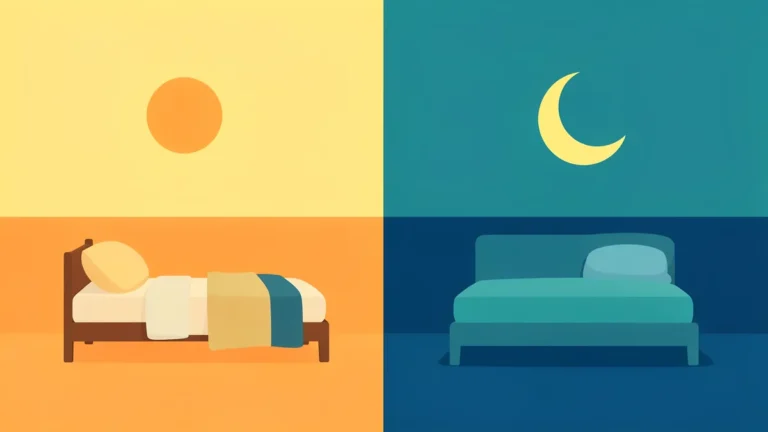
Biphasic sleep means sleeping in two parts each day instead of one. The most common version is a main night sleep plus an afternoon nap. It can work well if the total adds up to enough rest, but it is not right for everyone (Sleep Foundation).
Want to build a split schedule? The polyphasic sleep calculator lays out sleep blocks around your wake time.
Monophasic, Biphasic And Polyphasic Sleep
These three words describe how many sleep periods you have in 24 hours.
- Monophasic: one block of sleep, usually at night.
- Biphasic: two blocks, also called segmented or bimodal sleep.
- Polyphasic: three or more blocks. Babies sleep this way (Sleep Foundation).
Most adults in the United States sleep in one block. But splitting sleep is not new, and many people drift toward it on their own. If you want the full picture of how sleep is built, start with the sleep cycle science guide.
Common Biphasic Schedules
There is no single biphasic plan. The Sleep Foundation lists three main patterns (Sleep Foundation).
| Pattern | Night sleep | Second sleep |
|---|---|---|
| Siesta | About 5 to 6 hours | 60 to 90 minute afternoon nap |
| Midday nap | About 6 to 7 hours | 20 to 30 minute nap |
| First and second sleep | Starts around 9 or 10 p.m. | Wake for 1 to 2 hours near midnight, then sleep again |
Every pattern should still add up to at least 7 hours in 24 hours. Splitting sleep does not lower how much you need.
Why Your Body Wants An Afternoon Nap
Many people feel a dip in energy in the early afternoon. Research on this “post-lunch dip” shows it is tied to higher sleep need. It can happen even if you skip lunch or do not know what time it is, and a heavy lunch can make it worse. The circadian rhythm calculator can map your own energy curve.
So the urge for a nap is not laziness. It is part of how the body clock works. Naps are one way to respond to it, and a short walk or daylight is another.
Is Segmented Sleep Natural?
Historian Roger Ekirch found many accounts of people sleeping in two parts before modern lighting. He describes segmented sleep as common across pre-industrial Europe, and he found reports in about eight non-Western groups as well. Other researchers dispute how widespread it was (Ekirch 2016).
The takeaway is simple. Humans have slept in different patterns, and one block is not the only normal option. But history does not prove a split plan is healthier for you today.
What The Research Says About Naps
Most of the health data for biphasic sleep comes from napping studies. They are mostly observational, so they show links, not cause and effect.
A Greek study of 23,681 adults followed them for about six years. People who took siestas had a lower rate of death from heart disease, with a ratio of 0.66. Those who napped at least three times a week for 30 minutes or more had a ratio of 0.63 (Naska et al. 2007).
A Spanish study of more than 3,200 adults found that naps of 30 minutes or less were tied to 21 percent lower odds of high blood pressure. Longer naps were tied to higher body weight and 41 percent higher odds of several heart risk factors (NHLBI).
A review of 11 studies and 151,588 people found that naps of 60 minutes or more were linked to a higher risk of heart disease and early death. Shorter naps showed no clear link. The authors warn that people who are already sick may nap more (Yamada et al. 2015).
How A Nap Affects Your Night
A nap lowers your sleep drive, which is your body’s need for sleep. That is why a late nap can make bedtime harder (Sleep Foundation). Most experts suggest avoiding naps after 3 p.m. People with insomnia may be more sensitive to this effect.
The good news is that nappers often get as much or more total sleep in 24 hours than non-nappers. But naps are not an adequate replacement for night sleep.
Waking from a nap can also leave you foggy. Deep sleep starts about 30 minutes after you doze off, and recovery can take 30 to 60 minutes (Harvard Health). Learn more in our guide on how to get rid of sleep inertia.
Who Biphasic Sleep Suits
A split schedule can fit you if most of these are true.
- You can nap at the same time most days, ideally between 1 and 3 p.m.
- You fall asleep easily at night, even after napping.
- Your total sleep reaches at least 7 hours.
- You feel refreshed after short naps rather than groggy.
It is also a fair fit for people who work irregular hours, as long as the plan stays steady (Sleep Foundation).
Who Should Skip It
- People with insomnia. A nap can reduce the pressure you need to fall asleep at night (Sleep Foundation).
- Anyone who wakes groggy. If a short nap does not refresh you, Harvard suggests skipping it and improving night sleep instead (Harvard Health).
- People with strict schedules or caregiving duties. A fixed nap time may not be possible (Sleep Foundation).
- People who feel sleepy all day. Frequent daytime sleepiness or loud snoring can point to sleep apnea, so talk with a doctor (Harvard Health).
How To Try It For A Week
- Set your total. Aim for at least 7 hours across both blocks. The bedtime calculator helps you pick a night-sleep start time.
- Choose your nap slot. Early afternoon, about 1 to 3 p.m., is likely best (Sleep Foundation).
- Keep it short. Aim for 20 to 30 minutes. A 90-minute nap gives a full cycle but can hurt night sleep if taken late. The nap optimization calculator and the 90-minute sleep cycle calculator help you time it.
- Try a coffee nap. Some people drink coffee right before a short nap. Use the coffee nap calculator for timing.
- Track for one week. Note your energy, how fast you fall asleep at night, and any grogginess. Check your balance with the sleep debt calculator.
The Sleep Foundation advises trying any new schedule for at least one week before judging it (Sleep Foundation). If you wake in the night and cannot get back to sleep, see our waking up at night guide.
Special Cases: Older Adults And Shift Workers
Older adults who nap often report more waking at night, so a nap may trade away some night sleep (Sleep Foundation). If you are older and sleep well at night, you may not need a nap at all. If night waking is a problem, try cutting the nap first.
Shift workers are different. A nap of about 90 minutes can be refreshing and may suit people who work odd hours, since it covers a full sleep cycle. The catch is timing. A long nap taken late can still push bedtime back, so plan it well before the next sleep block (Sleep Foundation).
In both cases, the same rule applies. Keep the total near 7 hours or more, and judge the plan by how you feel after a full week.
Common Mistakes To Avoid
- Napping too late. A nap after 3 p.m. cuts into sleep drive and delays bedtime.
- Cutting night sleep too much. A nap does not make up for a night of 4 hours.
- Changing the time daily. A steady nap slot helps your body clock learn the pattern.
- Judging it too fast. The first few days can feel off. Give it a week.
FAQs
Is Biphasic Sleep Healthy?
It can be, if you reach at least 7 hours in total and the naps are short. Long naps of 60 minutes or more have been linked to higher health risks in large reviews, though those studies cannot prove cause (Yamada et al. 2015).
What Is The Best Biphasic Sleep Schedule?
There is no single best plan. A midday nap of 20 to 30 minutes with 6 to 7 hours at night is the easiest to fit into a work day. The siesta plan uses a longer nap and shorter night (Sleep Foundation).
How Is Biphasic Different From Polyphasic Sleep?
Biphasic uses two sleep blocks a day. Polyphasic uses three or more. Adults who sleep in several chunks without planning to may have a sleep problem and should see a doctor (Sleep Foundation).
What Time Should I Nap?
Early afternoon, around 1 to 3 p.m., works for most people. Napping late in the day can interfere with sleep at night (Harvard Health).
Does Napping Replace Night Sleep?
No. People who nap often get as much or more sleep across 24 hours, but naps are not an adequate substitute for a full night (Sleep Foundation).
Was Two-Part Sleep Normal In The Past?
Historical records suggest segmented sleep was common in pre-industrial Europe. Some researchers dispute how common it was elsewhere, so treat it as interesting history, not a health rule (Ekirch 2016).