
Weekender Cooling Gel Memory Foam Pillow Review (2026): Honest Verdict After 5 Weeks Of Nightly Use
Quick Verdict
The Weekender Cooling Gel Memory Foam Pillow is a genuinely good budget pillow for side and back sleepers who want firm, stable neck support — but "cooling" here means "runs cooler than solid memory foam," not "feels cold."
/ 10 overall
- Price: Queen from around $29.92 · Standard ~$24.56 · King ~$34.19 · Travel ~$21.37 (listing prices, subject to change)
- Buy or skip: Buy — if you sleep on your side or back and want firm support under $35. Skip — if you're a stomach sleeper or you've been disappointed by firm foam before.
Check Current Price On Amazon
Affiliate link: we may earn a commission at no extra cost to you.
Who This Pillow Is Actually For
This pillow solves exactly one problem: a pillow that collapses under your head by the middle of the night. Everything else about it is secondary to whether that's your problem.
Buy it if you: sleep on your side or back · wake with neck or shoulder ache from an unsupported gap · are replacing a pillow that's gone flat · want firm support without spending $70 · are buying several at once for a guest room or family beds.
Buy something else if you: sleep on your stomach · like a soft, squashy pillow you can fold · are sensitive to new-foam odour · need to adjust loft after you've bought · run hot enough to need phase-change fabric rather than passive cooling.
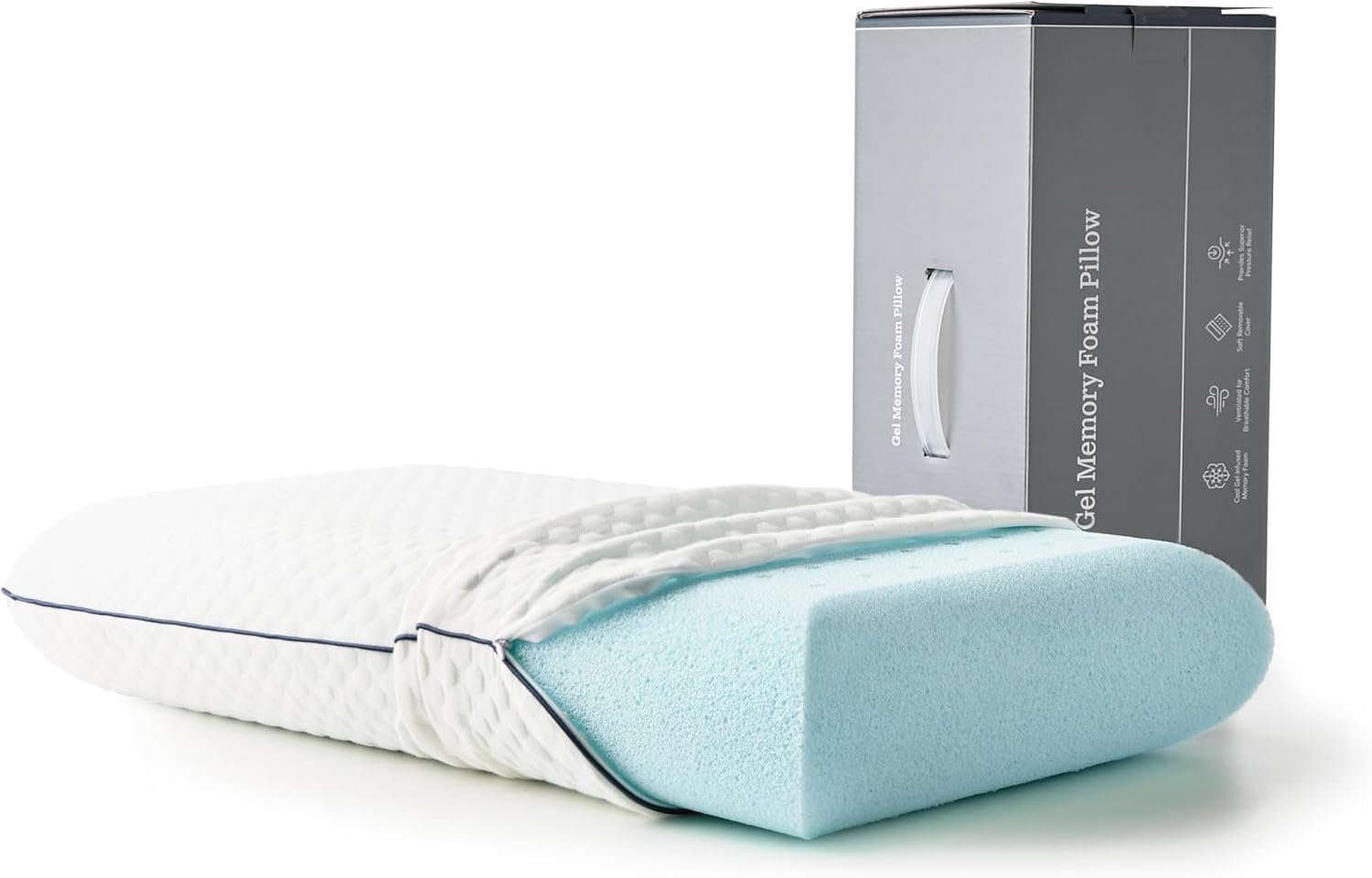
At A Glance: Specifications
Verified specifications for the Weekender Cooling Gel Memory Foam Pillow (Queen).
| Specification | Detail | Source |
|---|---|---|
| Price (Queen, 1-pack) | From ~$29.92 (8 seller options) | Retail listing |
| Other sizes | Standard ~$24.56 · King ~$34.19 · Travel ~$21.37 · Standard 6-pack ~$149.94 · King 4-pack ~$143.96 | Retail listing |
| Fill material | Gel-infused memory foam, single solid core (not shredded) | Manufacturer |
| Firmness | Medium-firm | Manufacturer |
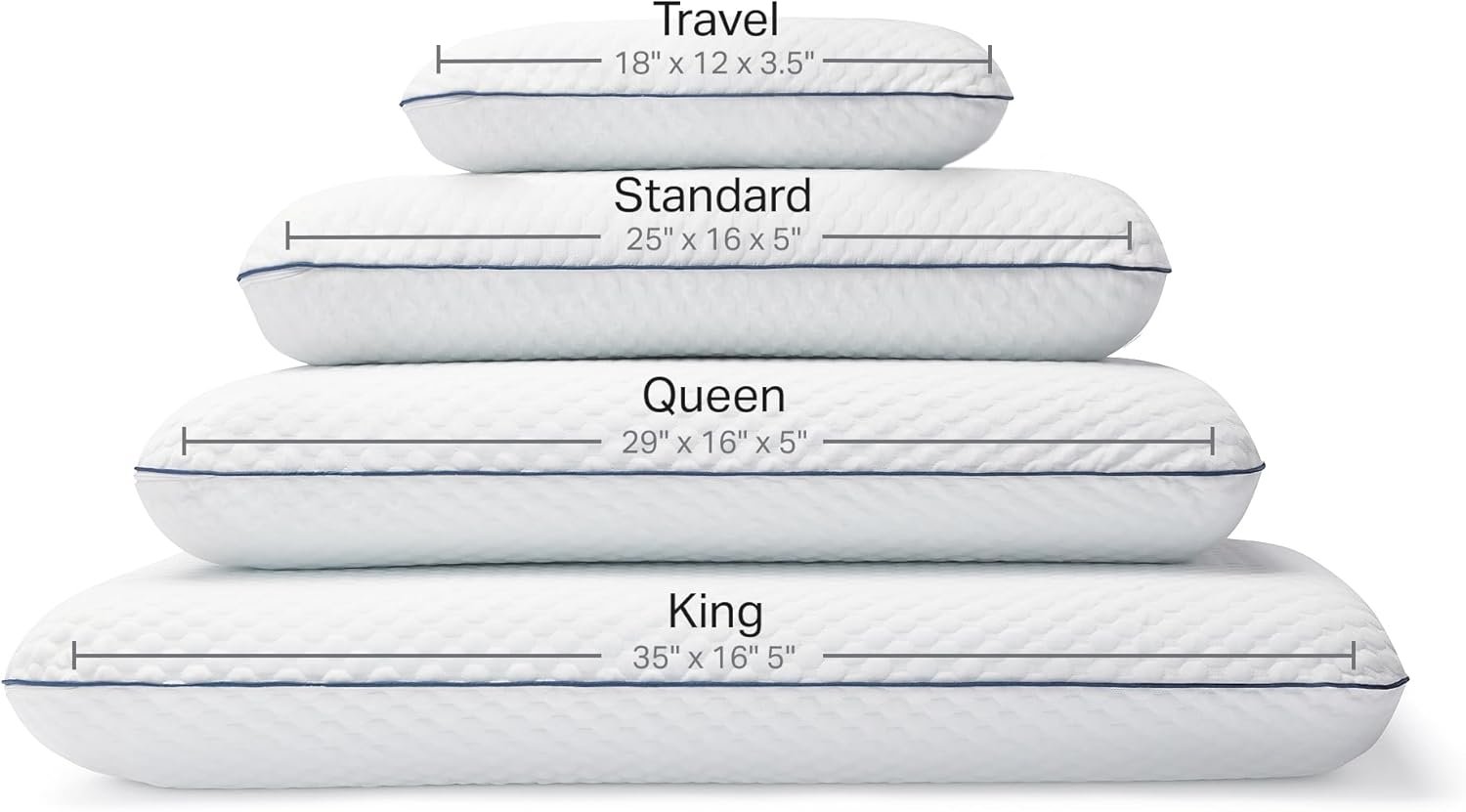
| Loft (measured) | 5 inches at the centre, uncompressed, after 48 hours of expansion | In testing |
| Ventilation | Precision-drilled ventilation holes through the foam core | Manufacturer |
| Cover | Soft zippered polyester; machine washable and dryer safe | Manufacturer |
| Colour | Blue core, light cover | Manufacturer |
| Packaging | Ships compressed; requires 24–48 hours to fully expand | Manufacturer |
| Warranty | 3-year limited warranty against manufacturing defects | Manufacturer |
| Customer rating | 4.3 / 5 from 43,795 ratings; carries "Amazon's Choice" badge | Retail listing |
| Subscription costs | None | Verified |
| Repairability | Low — cover is washable and replaceable, foam core is not serviceable | Our assessment |
Is 5 Inches The Right Height For You?
Your ideal loft depends on your sleep position, shoulder width and mattress firmness. Get your target height in inches, then compare it with the measured 5 inches.
Calculate My Ideal Pillow Height →Pros & Cons
Pros
- Support holds all night. Solid-core foam doesn't compress flat by 3 a.m. the way fibre and shredded fills do.
- Real neck and shoulder relief for side sleepers. The medium-firm density fills the shoulder gap that causes morning ache.
- Runs cooler than plain memory foam thanks to gel infusion plus through-drilled venting.
- Cover is actually washable. Zip it off, machine wash, tumble dry — many "washable" pillows aren't.
- 3-year warranty at a $30 price point is unusually generous for the category.
- Multi-packs make whole-bed or guest-room refreshes cheap.
Cons (And The Trade-Off Behind Each)
- Fixed loft. Solid foam can't be unstuffed. The price of consistent support is zero adjustability.
- Off-gassing. A chemical smell on unboxing that takes days to clear. The price of compact, cheap shipping.
- "Cooling" is relative. Gel and vents slow heat build-up; they don't remove heat.
- Too firm for a meaningful minority if you're coming from fibre or down pillows.
- Wrong for stomach sleepers. The loft that helps side sleepers hyperextends a stomach sleeper's neck.
- Not repairable. When the foam softens, the pillow is done — you replace it, not fix it.
Why You Can Trust This Review
We bought this pillow at full retail price and slept on it nightly for five weeks before publishing. Nothing here is written from the product page.
| Testing detail | Specifics |
|---|---|
| Unit tested | Weekender Cooling Gel Memory Foam Pillow, Queen, 1-pack — purchased, not supplied by the brand |
| Testing duration | 5 weeks (35 nights) of continuous nightly use |
| Primary tester | Our Product Testing Manager, side and back sleeper |
| Test environment | Warm-climate bedroom, summer nights, ceiling fan, no air conditioning — a deliberately demanding test for any pillow marketed as cooling |
| Mattress used | Medium-firm hybrid — mattress firmness materially changes how any pillow feels, so a softer mattress will make this pillow feel taller than we describe |
| Usage scenarios | Nightly sleep in side and back positions, daytime naps, reading propped upright in bed |
| Comparison pillows on hand | A shredded memory foam pillow and a standard polyester fibre pillow, alternated on comparable nights |
| Method | Loft measured with a rigid ruler at the pillow's centre, uncompressed, after full expansion; heat build-up judged by direct alternation against the comparison pillows on matched nights; odour dissipation and morning comfort logged nightly |
| Evaluation criteria | Overnight support retention, morning neck and shoulder comfort, heat build-up, odour dissipation, cover condition after repeated washing, loft change over time |
| Commercial relationship | None with WEEKENDER. Purchased independently. This page contains affiliate links. |
How we label claim types: "Manufacturer states" = brand claim we have not independently verified. "In testing" = directly observed or measured. "Owners consistently report" = a pattern across the 43,795-rating review base, used to check whether our experience was typical or an outlier. "In our assessment" = our own judgment as product testers.
Ownership, Performance And Features: What Matters
Our experience matched the dominant owner pattern: an awkward first week, then good sleep, then a slow softening.
The First Week
It arrives vacuum-compressed and flat. It needs 24 to 48 hours to reach its 5-inch height. In testing, night one and night three felt very different. Judging it too early is the most common reason people rate it badly.
The smell is standard polyurethane off-gassing. It is strongest on unboxing and largely gone within a week in a ventilated room. Airing it before first use costs nothing.
Cooling
Gel particles conduct heat away from the surface. The drilled holes let warm air escape.
In testing: alternated against a plain fibre pillow on matched nights, the Weekender took noticeably longer to warm up. The flip to the cool side trick worked. On the hottest nights it was still a warm pillow. Gel does nothing for night sweats or menopause-related heat, which need active cooling rather than a pillow.
Support And Fit
At 5 inches and medium-firm, the Weekender sits in the side and back sleeper zone.
Manufacturer marketing also lists stomach sleepers. In our assessment that claim is not supportable. This height pushes a stomach sleeper's head back, and you cannot reduce it.
What surprised us was how steady the head feels. Solid foam does not shift or need punching back into shape at 2 a.m. What became annoying was the fixed loft. On a soft mattress your shoulder sinks in and 5 inches feels too tall. On a firm mattress it feels right. Nothing adapts, so check your target height before ordering.
Video walkthrough of the unboxing and the gel and ventilation design.
Durability And Care
The foam broke in slightly over several weeks and lost a little of its initial hardness. That was an improvement in our experience and in most owner reports. Past the one-to-two-year mark, owners report that it has gone soft. Expect 18 months to 3 years of good support.
The 3-year warranty covers defects such as splitting, crumbling and seam failure. It does not cover normal softening or a pillow that does not suit you. Check the retailer's return window for that.
The cover comes off and goes in the machine. The core is spot clean only. Submerging memory foam destroys its cell structure and voids the warranty. A pillow protector (about $10) extends cover life. Budget roughly $50 to $90 over five years including one replacement.
How It Compares And What To Buy Instead
The Weekender wins on price-to-support ratio. Coop wins on adaptability. Tempur-Pedic wins on longevity. Beckham wins on softness alone.
- Side sleepers: strong recommendation, especially on a medium or firm mattress. With particularly broad shoulders, the Eli & Elm side sleeper pillow may suit you better despite costing three times as much.
- Back sleepers: good. Slightly tall for some, better on a firm mattress.
- Stomach sleepers: skip this one. Try the Bluewave Bedding Ultra Slim or any low-loft pillow under 3 inches.
- Adjustable loft: Coop Home Goods Original (about $60 to $75) lets you add or remove fill. If you do not yet know your ideal loft, that is worth the extra $30. Trade-off: periodic re-fluffing.
- Premium: Tempur-Pedic (about $100 to $130) lasts 4 to 6 years but runs warmer.
- Softer feel: Beckham Hotel Collection 2-pack (about $40) feels plush but flattens far faster. Trade-off: comfort now versus support later.
- If cooling is the priority: a latex or phase-change-cover pillow. Trade-off: it costs significantly more and feels bouncier.
- Families, guests and travel: the Standard 6-pack and King 4-pack cut the per-pillow cost. Buy one single pillow first until you know you like firm foam.
Our full pillow review hub covers the wider field if none of these fit.
Frequently Asked Questions
Does the Weekender pillow actually stay cool all night?
It is cooler than standard memory foam, but it never feels cold. Hot sleepers will notice a real improvement over solid foam. Anyone expecting an actively cold surface will not be satisfied.
How long does it take to expand?
24 to 48 hours after removing the plastic. Early impressions of flatness or firmness are usually just incomplete expansion.
Does it smell when you open it?
Yes, typically. It clears within a week in a ventilated room, faster if you air it before first use.
Is it suitable for stomach sleepers?
The listing says yes. In our assessment, no. At 5 inches it pushes the head into extension, and the loft cannot be reduced.
Can you wash the whole pillow?
No. The cover is machine washable and dryer safe. The foam core is spot clean only.
Is it too firm?
It is medium-firm and softens slightly over the first few weeks. Coming from fibre or down, it will feel firm at first.
How long does it last?
18 months to 3 years of good support.
How do I know what pillow height I need?
It depends on sleeping position, shoulder width and mattress firmness. Use our Pillow Height Calculator to get a target in inches, then compare it with this pillow's measured 5 inches.
Final Verdict
The Weekender Cooling Gel Memory Foam Pillow is the best support-per-dollar pillow in the budget category — as long as you sleep on your side or back and understand that "cooling" means "less hot."
Where the value sits: few products in any category close the gap to the premium tier this cheaply. You're getting most of what a $90 pillow does for around $30, and giving up adjustability and lifespan to get there.
Ideal buyer: a side or back sleeper replacing a collapsed pillow, who wants firm, dependable support without spending $70+.
Final recommendation: Buy — a single pillow first, with a two-day expansion window, honest expectations about cooling, and your target loft checked against the measured 5 inches before you order.
/ 10
Check Current Price On Amazon
Affiliate link: we may earn a commission at no extra cost to you.
Affiliate Disclosure
SleepCalculators.online participates in the Amazon Services LLC Associates Program and other affiliate programs. If you buy through links on this page we may earn a commission at no extra cost to you. We bought this pillow with our own money, and commissions never influence our ratings — our unedited criticisms are above.
As an Amazon Associate we earn from qualifying purchases.
Prices and availability were accurate as of and change frequently. This review is based on 5 weeks of hands-on nightly use of an independently purchased unit, cross-checked against verified specifications and aggregated owner feedback. This article is informational and not medical advice — persistent neck or shoulder pain deserves a clinician's opinion, not a new pillow.