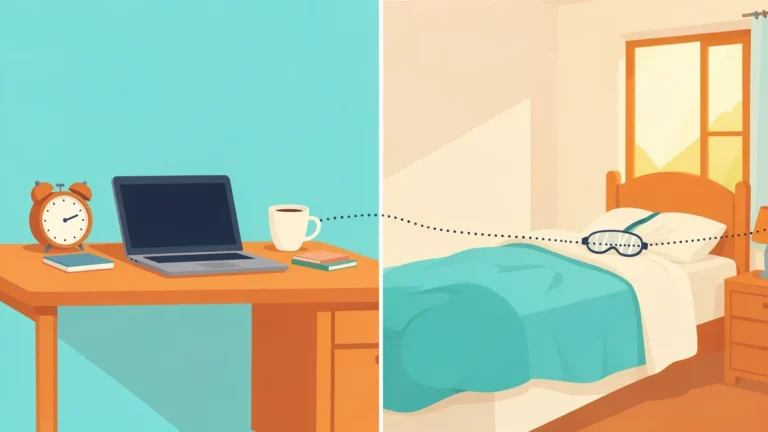
Social jet lag is the gap between the sleep your body wants and the sleep your schedule allows. If you sleep late on weekends and wake early on weekdays, your body clock is forced to shift back and forth, a bit like flying across time zones every week. Almost half of US adults have at least an hour of it (JAMA Network Open 2022).
Curious about your own body clock? The circadian rhythm calculator helps you find your natural sleep window.
What Is Social Jet Lag?
The term was coined by researcher Till Roenneberg. It describes a mismatch between your internal clock and the demands of daily life (ScienceDaily). A review defines it as the gap between biological time and social time (review in PMC).
Roenneberg compares it to flying from Frankfurt to New York every Friday and flying back every Monday. Late nights on Friday and Saturday, plus sleeping in, set it off (Harvard Gazette). He also says about 85 percent of people need an alarm clock to wake up.
How Social Jet Lag Is Measured
Researchers measure it with your midsleep time, the halfway point between falling asleep and waking up. Social jet lag is the difference between your midsleep on free days and your midsleep on work or school days (review in PMC).
Here is an example. On weekdays you sleep from 11:30 p.m. to 6:30 a.m., so your midsleep is 3:00 a.m. On weekends you sleep from 1:00 a.m. to 9:00 a.m., so your midsleep is 5:00 a.m. The gap is 2 hours, which is 2 hours of social jet lag.
How Common Is It?
Very common. In a study of 9,004 US adults, the average social jet lag was 1.1 hours. About 46.5 percent had at least 1 hour, and 19.3 percent had at least 2 hours. People slept 7.6 hours on workdays and 8.2 hours on free days (JAMA Network Open 2022).
A review says that in industrialized countries about two-thirds of working and studying people have it (review in PMC). In a Japanese study of 1,404 workers, 28.4 percent had 1 to 2 hours and 8.1 percent had 2 hours or more (Furukawa et al. 2020).
Who Is Hit Hardest?
Evening types and teens are most affected. Evening types have a late body clock, but work and school start early. Teen clocks run late during adolescence, and shift workers can face up to 3 hours of it (review in PMC). It is worst for the late types, such as adolescents (Harvard Gazette).
If you are a natural night owl, read chronotypes explained to see why your clock runs late.
Signs You May Have Social Jet Lag
You may have it if several of these sound like you.
- You need an alarm on weekdays but wake on your own on weekends.
- You feel foggy and slow on Monday mornings.
- You cannot fall asleep on Sunday night, even though you slept in.
- Your bedtime on Friday and Saturday is more than an hour later than on weeknights.
To see how steady your pattern is, try the sleep consistency calculator. For a deeper look at timing, read best time to sleep.
Health Links To Know About
Social jet lag has been linked to several health problems. Most studies are one-time snapshots, so they show links, not cause.
- Mood. In the Japanese study, 2 hours or more was linked to 2.14 times the odds of depressive symptoms compared with under 1 hour. Each extra hour raised the odds by 35 percent (Furukawa et al. 2020).
- Blood sugar. The New Hoorn study of 1,585 people found that 2 hours of it went with about double the risk of pre-diabetes and type 2 diabetes (review in PMC).
- Weight. More severe social jet lag goes with being overweight, and with more alcohol and caffeine (ScienceDaily).
- Blood pressure. A one-year study of 625 adults found small links with blood sugar, triglycerides and diastolic blood pressure, but not systolic (Mota et al. 2021).
The picture is not the same for every outcome. For example, four studies found no link with blood pressure, and the evidence on mood disorders is mixed (review in PMC).
Does Weekend Catch-Up Sleep Help?
It helps a little, but it does not fix the underlying problem. Roenneberg says sleeping in for a couple of mornings can reduce sleep debt, and another expert says extra sleep on free nights is useful (Harvard Gazette). Check your balance with the sleep debt calculator.
But a lab study found that people who cut back on sleep during the week and caught up on weekends still ate more after dinner, burned less energy, gained weight and had worse insulin responses (Harvard Health). So the best plan is to sleep enough every night and keep your times close together.
How To Fix Social Jet Lag
- Pick a wake time you can keep every day. The Sleep Foundation advises a bedtime and wake time you can hold even on weekends (Sleep Foundation). Our best time to wake up guide helps you choose one.
- Keep your weekend wake time near your weekday time. A small gap, such as an hour, is easier on the body than a big one. That limit is our rule of thumb, not a tested cutoff.
- Move in small steps. Shift your bedtime and wake time by 15 to 30 minutes over a series of days (Sleep Foundation).
- Get bright light in the morning. Morning light helps set the clock (Sleep Foundation). Use the bedtime calculator to plan an earlier night.
- Dim screens at night. Avoid screens for at least an hour before bed (Sleep Foundation).
- Use melatonin only with a doctor’s advice. It can help restart a sleep pattern in some cases, but check first (Sleep Foundation).
Weekend Morning Light Can Shift Your Clock
A small study of 37 teens tested bright light on weekend mornings. From Friday to Sunday, the body clock moved 0.6 hours earlier with room light and with 1.5 hours of bright light, and 1.0 hour earlier with 2.5 hours of bright light. About 54 percent of the 2.5-hour group moved at least an hour, compared with 8 percent in room light (PMC teen study).
The groups were not randomized, and the sample was small. Still, it suggests that a long, bright morning outdoors on the weekend can help a late clock.
Shift Workers And Students
Some people cannot match their schedule to their clock. Shift workers can face up to three hours of social jet lag (review in PMC). If this is you, see our guide on circadian rhythm explained and use the same tools: light at the right time, dark at the right time, and a steady pattern on days off.
The same review points to wider fixes, such as flexible school and work start times (review in PMC). If you can talk to an employer or school, a later start may do more than any sleep hack.
FAQs About Social Jet Lag
What Is Social Jet Lag In Simple Terms?
It is the gap between when your body wants to sleep and when your schedule lets you. It shows up as late weekend nights and early weekday alarms (Harvard Gazette).
How Many Hours Of Social Jet Lag Is Too Much?
There is no official cutoff. Studies often compare under 1 hour with 1 to 2 hours and 2 hours or more. Risks in studies were clearest at 2 hours or more (Furukawa et al. 2020).
Is Sleeping In On Weekends Bad?
A small sleep-in can repay some sleep debt. A big shift creates social jet lag and may harm your body clock. Try to keep your weekend wake time close to your weekday time (Harvard Gazette).
How Long Does It Take To Recover From Social Jet Lag?
Plan on days to weeks. Shift by 15 to 30 minutes over a series of days rather than all at once (Sleep Foundation).
Can Light Reduce Social Jet Lag?
It can help. Morning light helps reset the clock, and a small teen study found a larger shift with 2.5 hours of weekend bright light (PMC teen study).
Is Social Jet Lag The Same As Real Jet Lag?
No, but they feel alike. Real jet lag comes from crossing time zones once. Social jet lag comes from a clock that is out of step with your schedule week after week (ScienceDaily).