Quick Answer: No trial we found shows that foam, latex, innerspring or hybrid is the best mattress material. The research is about firmness. In a trial of 313 adults with chronic low back pain, medium-firm mattresses beat firm ones, and a review of 39 articles also favored medium-firm. We found no study that supports a set 7 to 10 year mattress life.
Match a mattress to your sleep position with our mattress sleep position calculator.
What Are The Main Mattress Types?
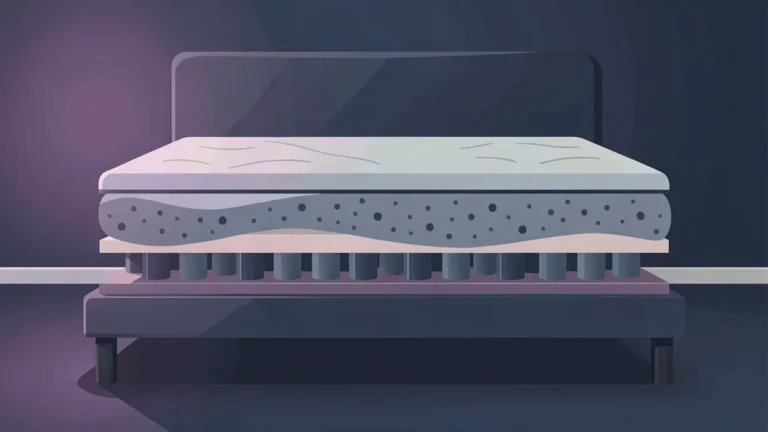
Five types cover most of the market. This table describes how each is built. It does not rank them, because the trials we read did not compare them head to head.
| Type | How it is built | Tested in the trials below? |
|---|---|---|
| Innerspring | Steel coils with a thin comfort layer | Not directly compared |
| Memory foam | Foam layers that soften with heat and pressure | One body-conforming foam bed tested |
| Latex | Natural or synthetic rubber foam | Not directly compared |
| Hybrid | Coils plus foam or latex layers | Not directly compared |
| Airbed or waterbed | An adjustable air or water chamber | One waterbed tested |
Does Mattress Firmness Matter For Back Pain?
Yes, in one large trial. Researchers assigned 313 adults with chronic non-specific low back pain to firm mattresses or medium-firm mattresses, without telling them which was which. At 90 days, medium-firm users had better outcomes for pain in bed (odds ratio 2.36, 95 percent CI 1.13 to 4.93) and for disability (odds ratio 2.10, CI 1.24 to 3.56). The result for pain on rising was weaker, with a range that included no effect (odds ratio 1.93, CI 0.97 to 3.86) (Kovacs and colleagues, 2003).
Firmness was rated on a European standard scale: 2.3 for the firm mattresses and 5.6 for the medium-firm ones. Store labels such as “firm” or “plush” may not map neatly onto that scale, so one company’s medium may feel different from another’s. The trial tested people who already had back pain, so it does not prove medium-firm is best for everyone.
What Did The Wider Reviews Find?
A systematic review of articles published through 2019 found 39 that qualified. It grouped mattresses as soft, medium-firm, extra-firm or customized, and concluded that a medium-firm mattress promotes comfort, sleep quality and spinal alignment. The authors also noted that the research disagrees about which type of mattress prevents back pain from starting (Caggiari and colleagues, 2021).
So the best-supported advice is about firmness and fit, and the evidence on the material is thin. Heat is a separate question from firmness, and the trials above did not test it. Our sleep temperature calculator can help with the bedroom side of that.
Do Foam And Waterbeds Beat A Hard Bed?
By a small margin. In a trial of 160 people with chronic low back pain, patients were randomly given a waterbed, a body-conforming foam mattress or a hard futon for one month. After dropouts, 141 were analyzed, and another 27 stopped early, which the researchers handled with worst-case and no-change analyses. Both the waterbed and the foam mattress seemed better than the hard one on back symptoms, function and sleep, with no relevant difference between them (Bergholdt and colleagues, 2008).
The authors said the differences were small. This is the closest trial we found to a comparison of types, and it tested only one product of each kind.
Does An Old Mattress Hurt Sleep?
It might. In a study of 59 people with minor sleep-related aches, personal beds averaged 9.5 years old. Volunteers recorded back discomfort and sleep quality for 28 days on their own beds, then for 28 days on new medium-firm beds. Sleep quality and sleep efficiency improved, and back discomfort fell (Jacobson and colleagues, 2009).
There was no control group and no blinding, and people knew they had a new bed, so expectations may explain part of the effect. It shows a worn bed could be part of a sleep problem, not how many years a mattress should last. Our mattress age impact estimator offers a rough check.
Do New Mattresses Stay Free Of Dust Mites?
No. Researchers tracked six identical new mattresses for two years and measured the main dust mite allergen. It rose significantly by 4 months and did not differ across later checks. The authors said new mattresses can become a significant source of mite allergen within about 4 months, and saw little reason to advise mite-sensitive patients to replace a mattress as a way to avoid allergens (Custovic and colleagues, 1996).
That is a very small study of six mattresses. It suggests that replacing a mattress is not a fix for mite allergy. If you have allergies, ask your clinician what is worth trying. For the pillow side of this question, see how often to replace a pillow.
How Strong Is This Evidence?
It varies a lot. The firmness trial was randomized and blinded, which makes it the strongest piece. The waterbed and foam trial was single-blinded and lost a share of its patients, so its small differences carry more doubt. The new-bed study had no control group, and the mite study followed only six mattresses. We did not check who paid for any of these studies.
Most of the trials also enrolled people with back pain, not healthy sleepers. If you have no pain, the findings may apply less. The wider review looked at sleep quality too, and it points the same way, but it cannot tell you which brand or material to buy.
What Should You Test Before Buying?
Because the research cannot pick a material for you, use your own body as the test. Lie in your usual position for at least ten minutes, side, back or stomach. Check that your spine looks level from behind and that your shoulders and hips do not sink or press. Ask your partner to move around and see how much you feel it.
These checks are common retail advice, not results from the studies above. They are a sensible way to apply the finding that fit and medium firmness matter.
Is There A Proven Mattress Lifespan?
We found none. The old advice that a mattress lasts 7 to 10 years comes mostly from manufacturers, not from trials, so treat it as a rough rule. Signs it may be time to replace yours are more useful:
- You wake with back or hip pain that eases during the day.
- You sleep better in a hotel or on another bed.
- There are visible sags, dips or broken coils.
- Your needs changed, for example after a weight change or new pain.
How Should You Choose A Mattress?
These are practical suggestions, not study results. Start with medium firmness if you have back pain, then adjust. Lie on the mattress in your usual sleep position for several minutes in the store. Check the trial period and return terms before you buy, since a few weeks at home tells you more than a few minutes in a showroom. Pair your mattress with a suitable pillow, and read how to choose a pillow when you do.
If you tend to sleep hot, treat heat as a separate question, since the trials here did not test cooling. Also check your overall sleep time. See how much sleep you need before blaming the bed.
When To See A Doctor
Talk to a doctor if back pain lasts more than a few weeks, wakes you at night, or comes with leg weakness, numbness or fever. A new mattress will not fix a medical problem.
If you have back pain with loss of bladder or bowel control, or sudden leg weakness, go to the emergency room or call 911.
FAQs About Mattress Types
What Is The Best Type Of Mattress?
No trial we found shows one material is best. The research favors medium firmness for people with chronic low back pain.
Is Memory Foam Better Than Innerspring?
We found no trial that compares them. One trial found a foam mattress and a waterbed slightly better than a hard futon.
How Firm Should A Mattress Be For Back Pain?
In a 313-adult trial, medium-firm mattresses did better than firm ones at 90 days for pain in bed and disability.
How Often Should You Replace A Mattress?
No study sets an interval. Replace it when it sags, hurts your back or no longer supports you.
Do New Mattresses Reduce Dust Mites?
Not for long. In a six-mattress study, mite allergen rose significantly within 4 months of use.
Do Hybrid Mattresses Sleep Better?
We found no trial that tested hybrids against other types, so we cannot say.
Does An Expensive Mattress Mean Better Sleep?
We found no trial that links price to sleep outcomes. Fit and firmness matter more than the label.
Sources
- Effect of firmness of mattress on chronic non-specific low-back pain: randomised, double-blind, controlled, multicentre trial (Lancet, 2003)
- Better backs by better beds? (Spine, 2008)
- What type of mattress should be chosen to avoid back pain and improve sleep quality? Review of the literature
- Changes in back pain, sleep quality, and perceived stress after introduction of new bedding systems
- New mattresses: how fast do they become a significant source of exposure to house dust mite allergens?