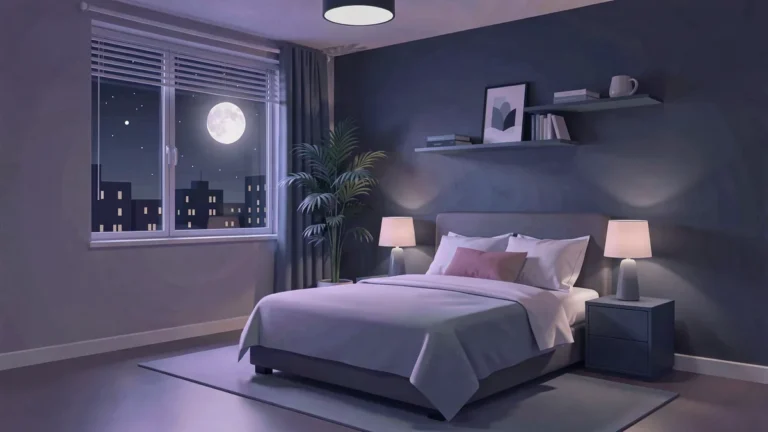
The ideal sleep environment is cool, dark, quiet and well aired, with a mattress and pillow that keep your spine level. Aim for a bedroom near 65 degrees Fahrenheit (18.3 degrees Celsius). Make it as dark as you can. Cut disruptive noise and keep indoor humidity in a comfortable range.
Those conditions, plus a supportive bed, do most of the work. This guide gives the target for each one and points you to the deep guide or tool that helps you dial it in.
- Set the room to about 65 degrees Fahrenheit (18.3 degrees Celsius) so your core temperature can fall for sleep.
- Make it as dark as you can. Even light at a lux of 10 or higher in the evening is linked to more awakenings.
- Keep it quiet. The WHO suggests under 30 dB(A) at night. If you cannot remove the noise, add a steady masking sound.
- Hold indoor humidity between 30 and 50 percent, and let fresh air in when you can.
- Replace a mattress once it sags or stops supporting you, usually after 7 to 10 years.
No product picks here. This is an evidence-based setup guide, not a shopping list. It gives the target for each part of the room and points you to the right calculator or guide. The choices stay yours and stay brand-neutral.
A good room still needs a sensible schedule. Once your bedroom is set up, use the sleep calculator to pick a bedtime that fits your wake-up time.
What Makes A Bedroom Good For Sleep?
A sleep-friendly bedroom manages six things: temperature, light, noise, the sleep surface, bedding and the air you breathe. Your senses stay partly active during sleep. Heat, a stray light or a sudden sound can pull you into a lighter stage. It can even wake you without you remembering it.
The table below is the whole checklist in one place. The sections after it explain each row and link the tool that helps.
| Factor | Target | Why it matters |
|---|---|---|
| Temperature | About 65 F (18.3 C), roughly 65 to 68 F | Your core temperature drops for sleep; a cooler room supports it (Sleep Foundation) |
| Light | As dark as possible; dim the hours before bed | Light slows melatonin; even low light raises night awakenings (Sleep Foundation) |
| Noise | Quiet, or steady masking sound | Noise shifts you to lighter sleep and fragments the night (Sleep Foundation) |
| Mattress | Keeps the spine level for your position and weight | A newer, well-matched mattress supports better sleep and less back pain (Sleep Foundation) |
| Pillow | Fills the gap so the neck stays neutral | Loft that suits your position keeps the head aligned with the spine |
| Bedding | Breathable layers; sheets washed often | Comfort and cleanliness cut overheating and allergens (Sleep Foundation) |
| Air and humidity | Ventilated; humidity 30 to 50 percent | Fresh air and controlled moisture limit stuffiness and mold (EPA) |
The NHLBI sums up the core in one line. Keep your bedroom quiet, cool and dark. A dim night light is fine if you need one (NHLBI).
How Cool Should The Bedroom Be?
Most people sleep best in a bedroom of about 65 degrees Fahrenheit (18.3 degrees Celsius). A reasonable range is roughly 65 to 68 F (Sleep Foundation).
Your core body temperature falls before and during sleep, as the body sends heat away from the core. A cooler room signals that bedtime is near and supports that process. A room that is too warm gets in the way. You may feel restless and get less deep, restorative sleep (Sleep Foundation).
The right setting still depends on your bedding, your sleepwear and your climate. Treat 65 F as a starting point and adjust a few degrees for comfort.
Not sure where to set the thermostat for your bedding and climate? The sleep temperature calculator turns these factors into a target room temperature and a bedding plan.
How Dark Should The Room Be?
Sleep in as much darkness as you can. In response to darkness, the brain releases melatonin, the hormone that makes you drowsy. Light exposure slows or halts that release (Sleep Foundation).
It does not take much light. Exposure to light with a lux of 10 or higher later in the evening is linked to more nighttime awakenings and less slow-wave sleep (Sleep Foundation).
Two moves help most. First, block outside light with blackout curtains or an eye mask, which can improve sleep quality. Second, dim the lights in the hour or two before bed and cut screen use. Blue light has a larger effect on melatonin and the body clock than other wavelengths (Sleep Foundation).
Want to see how much evening light you are getting and when to stop? The blue light exposure calculator estimates your evening screen dose and suggests a cut-off time.
How Quiet Does It Need To Be?
Quiet enough that sound does not keep pulling you out of deep sleep. The World Health Organization recommends keeping bedroom noise below 30 A-weighted decibels, written dB(A), during the night for good-quality sleep (WHO).
Environmental noise such as traffic has been shown to increase light stage 1 sleep. It also decreases slow-wave and REM sleep. Loud disturbances can cause severe sleep fragmentation (Sleep Foundation; Sleep Foundation). The next day, that can show up as sleepiness and irritability.
If you cannot remove the noise, you can cover it. Earplugs, alone or with an eye mask, help hospital patients wake less often and get more deep sleep.
Steady background sound can help too. In one study, white noise helped people fall asleep 38 percent faster. Results vary, and the benefit often comes down to personal preference (Sleep Foundation).
Wondering whether a white noise machine or fan is worth it for your room? The white noise benefit calculator weighs your noise problem against what masking is likely to do.
What About The Mattress?
A mattress should keep your spine level while it relieves pressure. A newer, well-matched mattress is linked to better sleep quality and less back pain than an old one (Sleep Foundation).
The right firmness is not one number for everyone. It depends on your main sleep position and your body weight. Side sleepers usually need more give at the hips and shoulders. Stomach sleepers usually prefer firmer models. The same mattress feels softer to a heavier person and firmer to a lighter one (Sleep Foundation).
This pillar does not pick a bed for you. For the firmness that matches your position and weight, use the mattress sleep position calculator. To learn how foam, latex, innerspring, hybrid and airbed feel and perform, read mattress types explained.
Most mattresses last between 7 and 10 years before support fades (Sleep Foundation). An aching back on an old bed is a sign to check its age.
What About Pillows?
A pillow should fill the space between your head and the mattress. That keeps your neck in line with the rest of your spine. Side sleepers generally need a higher, firmer pillow to bridge the shoulder. Back sleepers, and especially stomach sleepers, need a lower one.
Get the loft right with the pillow height calculator. For materials and shapes, see how to choose a pillow.
Pillows also wear out and collect allergens, so they are not a buy-once item. Our guide to how often to replace a pillow covers the timing and the signs it is time.
Bedding And Weighted Blankets
Choose breathable sheets and layers you can add or shed. Bedding helps you hold the cooler room temperature without getting cold.
Keep it clean, too. Washing sheets at least every couple of weeks reduces dust mites, the tiny allergens that build up in bedding (Sleep Foundation).
Some people find a weighted blanket calming. It works through deep pressure stimulation, the gentle, even pressure that can feel like being held. A common guide is a blanket around 10 percent of your body weight (Sleep Foundation).
It is a supportive tool, not a cure, and it is not for everyone. Anyone with sleep apnea, asthma, low blood pressure or claustrophobia should check with a doctor first. A child must be able to push it off on their own (Sleep Foundation). The weighted blanket calculator turns your weight into a sensible starting size.
Air Quality And Humidity
Fresh, well-aired air helps the room feel restful. It also keeps pollutants from building up. When too little outdoor air gets in, indoor pollutants can reach levels that cause headaches, tiredness and irritation of the eyes, nose and throat (EPA).
Simple ventilation helps clear them. Open a window when practical. Vent moisture from cooking and showers to the outdoors (EPA).
In one controlled bedroom study, more ventilation from an open window or door lowered carbon dioxide levels. It was linked to better sleep and sharper next-day performance (Strom-Tejsen et al., Indoor Air 2016).
Humidity is the other half. The EPA advises keeping indoor humidity below 60 percent, ideally between 30 and 50 percent. Use air conditioning or a dehumidifier if needed. That range limits mold and feels more comfortable than air that is too damp or too dry (EPA).
There is no calculator for this one. A cheap hygrometer and a little ventilation usually settle it.
What About Phones, The TV And Clutter?
Keep screens and clutter out of the bedroom where you can. Smartphones, televisions and other screens give off light that suppresses melatonin. It is linked to less slow-wave sleep. Screens also pull you into one more scroll or episode when you should be winding down (Sleep Foundation).
Charge the phone in another room and keep the TV elsewhere. That removes both the light and the temptation. If a screen has to stay, the darkness section above covers how to limit its effect.
A tidy room helps in a quieter way. With less visual mess and fewer reminders of unfinished tasks, there is less to keep your mind switched on. This is general good practice, not a measured target. Still, it costs nothing to clear the nightstand and the floor.
Where The Room Ends And Habits Begin
A perfect bedroom cannot outrun a chaotic schedule or a racing mind. This page is about the physical room. The behavior side lives in our sleep hygiene checklist. It covers a fixed wake time, winding down and cutting caffeine.
If you are tempted to grade your new setup with a gadget, read are sleep trackers accurate first. You will know what the numbers can and cannot tell you.
When The Room Is Not The Problem
If your bedroom is already cool, dark and quiet and you still sleep badly for weeks, the cause is probably not the room. See a doctor if:
- you snore loudly, stop breathing or wake gasping, which can point to sleep apnea;
- trouble sleeping has lasted months or makes it hard to cope with daily life;
- you feel very sleepy during the day or while driving. Do not drive when you feel sleepy.
A good environment supports treatment. It does not replace it.
Ideal Sleep Environment FAQs
What Is The Best Temperature For A Bedroom?
About 65 degrees Fahrenheit (18.3 degrees Celsius). Roughly 65 to 68 F suits most people. Adjust a few degrees for your bedding and comfort.
Should My Bedroom Be Completely Dark?
As dark as you can manage. Even light at a lux of 10 or higher in the evening is linked to more awakenings. Use blackout curtains or an eye mask, and dim lights before bed.
Does White Noise Actually Help?
For some people. One study found white noise helped people fall asleep 38 percent faster. Results vary, and it comes down to personal preference. Earplugs are another option.
What Humidity Level Is Best For Sleep?
Keep indoor humidity below 60 percent, ideally between 30 and 50 percent. A dehumidifier or air conditioning helps in damp climates. Ventilation clears moisture.
How Firm Should My Mattress Be?
It depends on your sleep position and body weight. Side sleepers usually want more cushioning. Stomach sleepers usually want firmer. Use the mattress sleep position calculator to match it.
Should I Sleep With The Window Open?
Often yes, if it is safe to. In a controlled study, opening a bedroom window or door lowered carbon dioxide. It was linked to better sleep and next-day performance. Close it if outdoor noise, allergens or poor air quality would cost you more.