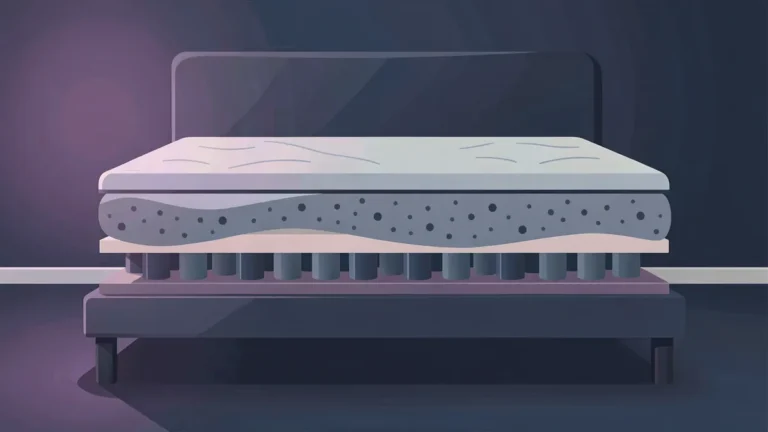
The five main mattress types are memory foam, latex, innerspring, hybrid and airbed. They differ most in feel, heat, motion and lifespan. Foam hugs the body but can trap heat. Latex is bouncy, cool and very durable. Innerspring is cool and cheap. A hybrid puts foam over coils. An airbed lets each side set its own firmness.
- Queen prices run from about 600 to 1,100 US dollars for innerspring up to 2,000 to 2,400 for an airbed (Sleep Foundation).
- Latex lasts longest, about 7.5 to 8.5 years. Innerspring is shortest at about 5.5 to 6.5 years.
- Most online mattresses include a 90 to 120 night sleep trial and a 10 to 20 year warranty.
- For couples, memory foam isolates motion best. For hot sleepers, innerspring and latex run coolest.
- Pick the firmness for your sleep position and body weight first, then choose the material.
This is the type overview for our ideal sleep environment guide. Here we compare the materials. The environment guide shows where the bed fits among temperature, light and noise.
The Mattress Types At A Glance
Every type is a trade-off between contouring, bounce, temperature and price. Use this table to narrow the field. The notes below add detail.
| Type | Feel and pressure relief | Temperature | Motion transfer | Durability | Best for |
|---|---|---|---|---|---|
| Memory foam | Deep contouring, high pressure relief | Can retain heat | Excellent isolation | About 6 to 7 years | Pressure relief, light sleepers, couples |
| Latex | Responsive, conforms but does not hug as deeply | Sleeps cool, resists heat buildup | More motion than memory foam | Among the most durable, 7.5 to 8.5 years | Bounce, eco-minded buyers, longevity |
| Innerspring | Bouncy, limited pressure relief | Sleeps cool, good airflow | Poor, coils transfer motion | Lower, about 5.5 to 6.5 years | Budget shoppers who want a classic feel |
| Hybrid | Balanced contour over supportive coils | Good, coils retain little heat | Moderate, better than innerspring | About 6.5 to 7.5 years | Those wanting bounce and contouring together |
| Airbed | Adjustable firmness per side | Varies by build | Varies by build | Varies, often long with upkeep | Couples with very different firmness needs |
Sources: Sleep Foundation mattress types, Sleep Foundation lifespan.
How Much Does Each Mattress Type Cost?
Price follows material more than brand. Innerspring is the cheapest type. Airbed is the priciest.
These are typical queen-size ranges from Sleep Foundation. A king costs more and a twin less. Premium models in any type run higher.
| Type | Typical queen price (US dollars) |
|---|---|
| Innerspring | 600 to 1,100 |
| Memory foam | 900 to 1,300 |
| Hybrid | 1,300 to 2,000 |
| Latex | 1,600 to 2,000 |
| Airbed | 2,000 to 2,400 |
Weigh price against lifespan. Latex costs more upfront but lasts longest. Its yearly cost can be closer than the sticker suggests.
How Long Does Each Type Last?
Most mattresses last 7 to 10 years before support fades (Sleep Foundation). The band differs by material. Latex lasts longest and innerspring the shortest. Foam and hybrid fall in between.
The chart shows the typical range for each. Quality, body weight and care all shift it.
Memory Foam And Other Foams
Foam mattresses are built for pressure relief. The surface cradles the hips and shoulders. Foam is also the best material for isolating motion, so you barely feel a partner moving (Sleep Foundation).
The main downside is heat. Dense foam can retain warmth. Foam suits side sleepers, lighter people and anyone who shares a bed with a restless partner.
Latex
Latex relieves pressure but does not hug as deeply as memory foam. The feel is more responsive and buoyant. It resists heat buildup, so it sleeps cooler. It is also one of the most durable materials available (Sleep Foundation).
The trade-offs are a higher price and more motion transfer than memory foam. It is a strong pick if you want bounce, a cooler surface and a long life.
Dividing each type’s midpoint queen price by its midpoint lifespan gives a rough yearly cost. Latex lands well above innerspring and foam but just under hybrid. Its longer life narrows the gap rather than erasing it.
Innerspring
Innerspring is the traditional coil mattress. It is bouncy and responsive. Air moves freely through the coils, so heat is rarely a problem (Sleep Foundation).
The comfort layer is thin, so pressure relief is usually limited. The coils also pass motion along, so you notice a partner’s movement. Direct pressure on the coils wears them faster. That gives innerspring the shortest typical lifespan. It suits budget shoppers who like a firm, classic feel.
Hybrid
A hybrid puts a real comfort layer over a pocketed coil core. The layer is often foam or latex. The aim is foam contouring with coil support and airflow.
Coils retain little heat, so hybrids generally regulate temperature well. Pocketed coils isolate motion better than a plain innerspring. They also add edge support (Sleep Foundation). Hybrids are a sensible default for couples and for people who cannot choose between foam and coils.
Airbed
An airbed uses adjustable air chambers, often one per side. Each sleeper can dial in their own firmness (Sleep Foundation). That makes it the natural choice for couples with very different tastes.
The trade-offs are cost and complexity. The pump and chambers are mechanical parts that need upkeep. Note that this is not a temporary air mattress, which lacks real support.
Type matters less than fit. Any of these types can be made soft or firm. Comfort depends on whether the firmness keeps your spine level in your usual sleep position. Your weight matters too.
Winner by need, from the comparison above:
- Coolest: innerspring and latex, because air moves through coils and latex resists heat buildup (Sleep Foundation).
- Best for couples: memory foam for the strongest motion isolation, or an airbed so each side sets its own firmness (Sleep Foundation).
- Longest-lasting: latex, at a typical 7.5 to 8.5 years (Sleep Foundation).
Which Type Should You Choose?
Start from how you sleep, not from the material. Side sleepers usually need more give at the hips and shoulders. Stomach sleepers usually prefer firmer models. The same mattress feels softer to a heavier person and firmer to a lighter one (Sleep Foundation).
Pick the firmness first. Then choose the type that delivers it with the heat, motion and durability you want.
This guide helps you shortlist types by position and body weight. It does not set a firmness number. The calculator does that.
| Sleep position | What your body needs | Types that tend to fit |
|---|---|---|
| Side | Give at the hips and shoulders | Memory foam, soft hybrid, latex |
| Back | Even support with light contour | Hybrid, medium foam, latex |
| Stomach | A firmer, flatter surface | Innerspring, firm hybrid |
| Heavier bodies, any position | Stronger support and durability | Hybrid, latex, sturdy innerspring |
| Lighter bodies, any position | A softer surface that still contours | Memory foam, soft hybrid |
Source: Sleep Foundation mattress firmness. A heavier person may sink past a soft comfort layer. So the same model can suit one partner and not the other.
To get an exact firmness for your sleep position and body weight, use the mattress sleep position calculator. If you run hot, the sleep temperature calculator helps you set the room. The right pillow for your position and its loft height keep your neck in line with your spine.
Already own a mattress? Age and sagging are the signals to watch (Sleep Foundation). The mattress age impact estimator weighs age, sag and your symptoms into a replace-or-keep call.
What About Sleep Trials And Warranties?
A sleep trial lets you test the mattress at home. You can return it for a refund if it does not suit you. The average trial runs 90 to 120 nights. Some are as short as 30 nights and others last a year or more (Sleep Foundation).
Many trials set a break-in period, often two weeks to a month. You must sleep on the bed that long before you can start a return. A new mattress needs time to adjust.
A warranty is separate. It covers manufacturing defects such as sagging beyond a set depth. It does not cover a change of mind. On average a warranty lasts 10 to 20 years, and some brands offer lifetime coverage (Sleep Foundation).
Check whether it is nonprorated or prorated. Nonprorated means the company covers an eligible repair or replacement in full. Prorated means you pay a share that grows as the mattress ages.
Mattress Types FAQs
Which Mattress Type Is Best?
There is no single best type. Choose the firmness that keeps your spine level in your sleep position. Then pick the type whose heat, motion and durability fit you.
Is Memory Foam Or Hybrid Better?
Memory foam isolates motion best and contours deeply, but it can sleep warm. A hybrid trades a little isolation for better airflow and bounce. Couples who run hot often prefer a hybrid.
Why Do Latex Mattresses Cost More?
Quality latex is expensive to produce. It is also durable and resists heat. The longer life can offset the higher price.
Which Mattress Type Sleeps Coolest?
Innerspring and latex tend to sleep coolest. Dense all-foam beds are the most likely to trap warmth.
Which Type Is Best For Couples?
Memory foam isolates motion best, so one partner is less likely to wake the other. Airbeds let each side set its own firmness. Hybrids offer a balanced middle ground.
How Long Should A Mattress Last?
Most last 7 to 10 years. See the lifespan chart above for the typical band by type.
How Much Does A Mattress Cost?
Typical queen prices run from about 600 US dollars for innerspring to 2,400 for an airbed. The cost table above lists each type.