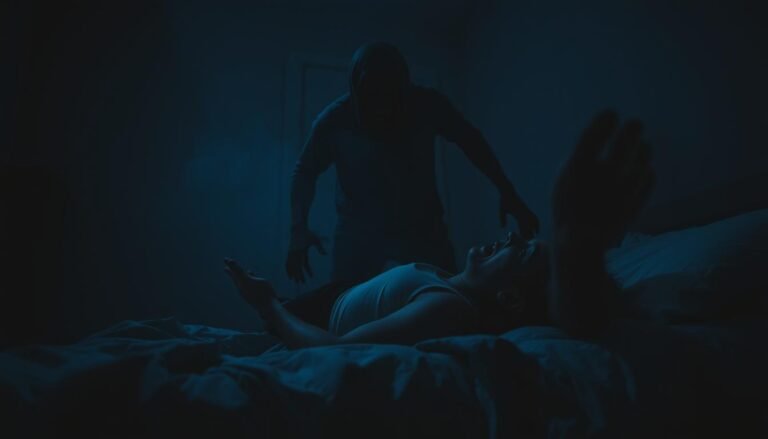
Sleep paralysis happens when the muscle relaxation of REM sleep carries on for a short time while you are falling asleep or waking up, so your mind is awake but your body cannot move yet. During REM (rapid eye movement) sleep your brain normally keeps your muscles still so you do not act out your dreams; this is called REM atonia. Sleep paralysis occurs when REM atonia happens at the edges of sleep (AASM Sleep Education). It is frightening, but on its own it is not a serious medical risk. The exact reason it happens is not known, but lack of sleep, an irregular schedule, sleeping on your back, stress and narcolepsy all make it more likely.
Wondering how likely you are to have episodes? The sleep paralysis risk calculator checks your sleep habits and the other factors linked to it.
What Causes Sleep Paralysis?
Sleep paralysis is a REM parasomnia: an unwanted event that happens during a move into or out of REM sleep. It can happen as you fall asleep (the hypnagogic form) or as you wake up (the hypnopompic form) (AASM). Researchers think it is a mixed state in which the muscle paralysis and dream imagery of REM sleep continue into a state of being awake and aware (Sleep Foundation).
REM is the stage in which most dreaming happens, and it returns several times a night in longer periods toward morning. You can read how it fits into the night in our guide to the stages of sleep. Too little sleep and an irregular sleep schedule are both linked to more frequent episodes.
Sleep paralysis is called “isolated” when it appears without any other signs of narcolepsy or another sleep disorder (AASM). When it keeps happening, doctors call it recurrent isolated sleep paralysis.
What Does An Episode Feel Like?
During an episode you may be unable to speak or move your arms, legs, body and head. You can still breathe normally and you are fully aware of what is happening. Episodes last from seconds to a few minutes and usually end on their own (AASM). The NHS describes feeling awake but unable to move, speak or open your eyes, feeling as if someone is in the room or something is pushing you down, and feeling frightened (NHS).
Hallucinations
Many episodes come with hallucinations that feel different from ordinary dreams. The Sleep Foundation groups them into three types (Sleep Foundation):
- Intruder hallucinations: sensing a threatening person or presence in the room.
- Chest pressure hallucinations: a feeling of suffocation or of someone sitting on your chest. These often come together with intruder hallucinations.
- Movement hallucinations: feelings of floating, flying or being outside your body.
Even though breathing carries on normally, chest pressure can make it feel hard to breathe, and panic or helplessness are common (Sleep Foundation).
Why There Are So Many Folk Names For It
Because the intruder and chest pressure experiences are so vivid, people in many cultures have explained sleep paralysis through stories of night spirits or “sleep demons”, while others see it as a spiritual sign. How people describe an episode varies a lot with their culture (Sleep Foundation). These stories are part of history and culture; medically, the experience is explained by REM sleep features carrying over into waking.
Causes And Triggers
No single cause has been found, and researchers think several factors work together (Sleep Foundation). The factors linked to it include:
- Lack of sleep. Sleep deprivation can make sleep paralysis more likely (AASM).
- An irregular schedule. A sleep schedule that often changes raises the chance (AASM), and the NHS lists disrupted sleep from shift work or jet lag (NHS).
- Sleeping on your back. It seems to happen more often in this position (AASM).
- Stress and mental health. Mental stress may be a factor (AASM), and it has been linked with PTSD, generalised anxiety disorder and panic disorder (NHS).
- Other sleep problems. Insomnia and narcolepsy are linked to it (NHS), and higher rates are reported in people with obstructive sleep apnea and nighttime leg cramps (Sleep Foundation).
- Medicines and other conditions. Bipolar disorder, the use of certain medicines and sleep-related leg cramps may play a part (AASM). Stopping alcohol or antidepressants can cause a rebound in REM sleep, which may also bring on episodes (Sleep Foundation).
- Family history. You may be more likely to have it if a relative does (AASM).
Trigger, Why It Matters And What To Do
| Trigger | Why it matters | What to do |
|---|---|---|
| Too little sleep | Sleep loss can bring on episodes | Aim for 7 to 9 hours a night on a regular basis |
| Irregular schedule, shift work or jet lag | A changing schedule disrupts the normal sleep pattern | Go to bed and get up at about the same time every day, weekends included |
| Sleeping on your back | Episodes seem to happen more often in this position | Try sleeping on your side |
| Stress, anxiety or PTSD | Linked with more frequent episodes | Daily stress management; ask a doctor about therapy such as CBT |
| Late alcohol, caffeine or heavy meals | They disturb sleep close to bedtime | Avoid them shortly before bed |
| Change in medicine | Some medicines, or stopping them, can affect REM sleep | Discuss it with your doctor; do not stop a medicine on your own |
| Heavy daytime sleepiness | Can be a sign of narcolepsy | See a sleep doctor |
The advice in the table comes from the AASM, the NHS and the Sleep Foundation (AASM; NHS; Sleep Foundation).
Who Gets Sleep Paralysis?
It can affect men and women of any age. It usually first appears in the teen years, at an average age of 14 to 17, and happens most often in people in their 20s and 30s. It is a fairly common sleep problem, although estimates of how many people have it vary widely, from 5% to 40% (AASM). Some people have only one episode in their life, while others have many in a year.
Is Sleep Paralysis Dangerous?
For most people, no. The episode may be frightening, but it is not a serious medical risk on its own and does not keep you from getting the sleep you need (AASM). The NHS describes it as scary but harmless (NHS).
The bigger problem for some people is fear of it happening again. A minority have frequent or very distressing episodes and may start to dread going to bed, which can cut sleep short and lead to daytime sleepiness (Sleep Foundation). Less sleep can in turn make episodes more likely, so breaking that loop is worth the effort.
How To Stop An Episode
An episode usually ends on its own. It may also end when someone touches you or speaks to you, or when you make an intense effort to move (AASM). Things that may help in the moment (Sleep Foundation):
- Remind yourself what it is. It is temporary and not dangerous, and knowing this may reduce panic.
- Try a small movement, such as wiggling a finger or toe.
- Breathe slowly and steadily. Your breathing works normally even if your chest feels heavy.
- Focus your eyes on one point if they are open.
How To Prevent Sleep Paralysis
You may be able to prevent episodes by changing your sleep habits (NHS):
- regularly get 7 to 9 hours of sleep;
- go to bed at roughly the same time each night and get up at the same time each morning;
- get regular exercise, but not in the last hour before bed;
- do not eat a big meal, smoke, or drink alcohol or caffeine shortly before bed;
- do not sleep on your back.
When sleep paralysis is not linked to another disorder, a regular sleep schedule and good sleep hygiene can help, and cognitive behavioral therapy for anxiety and stress may be useful (AASM). Our sleep hygiene guide covers the basics. Putting devices away for an hour before bed and daily stress management, such as journaling or deep breathing, are also suggested (Sleep Foundation).
The Link With Narcolepsy
Sleep paralysis can be one sign of narcolepsy. The other signs are excessive daytime sleepiness, broken night sleep, sleep-related hallucinations and cataplexy (AASM). Cataplexy is sudden muscle weakness triggered by strong emotions such as laughter, fear, anger or excitement; the person stays fully conscious. Sleep paralysis resembles cataplexy, except that it happens at the edges of sleep (NINDS).
In narcolepsy the line between sleep and wakefulness is blurred, so people often enter REM sleep within about 15 minutes of falling asleep and can have REM muscle weakness or dream activity while awake (NINDS). People with narcolepsy often have sleep paralysis (AASM), and some antidepressant medicines can help reduce their sleep paralysis and hallucinations (MedlinePlus). Learn more in narcolepsy explained.
When To See A Doctor
You do not usually need medical help for sleep paralysis unless it affects your sleep or mental health (NHS). See a doctor if:
- Episodes are frequent and you feel very anxious or scared to go to sleep (NHS).
- They keep you up at night or leave you very tired during the day (AASM).
- You also have heavy daytime sleepiness, sudden sleep attacks, or muscle weakness when you laugh or feel strong emotions, which can point to narcolepsy (AASM; NINDS).
- Episodes started after a change in medicine, or come with leg cramps (AASM).
Most people need no tests. The doctor will ask when the episodes started, how often they happen and how long they last, and about your medicines and other sleep problems; a two-week sleep diary helps. A sleep study, and a daytime nap test called the Multiple Sleep Latency Test (MSLT), are used if another sleep disorder such as narcolepsy is suspected (AASM). A GP may treat an underlying cause such as insomnia or PTSD, and a specialist may suggest a low dose of a medicine usually used for depression, or CBT (NHS). For other signs worth raising, see signs of a sleep disorder.
Sleep Paralysis FAQs
How Long Does Sleep Paralysis Last?
Usually from a few seconds to a few minutes. Most episodes end on their own.
Can You Die From Sleep Paralysis?
No. You keep breathing normally during an episode, and on its own it is not a serious medical risk, even when it feels like you cannot breathe.
Why Do People See A Figure During Sleep Paralysis?
Dream imagery from REM sleep carries over while you are awake, so the brain can produce a strong sense of a presence in the room. These hallucinations are a known part of sleep paralysis and can also happen without it.
Is Sleep Paralysis A Sign Of Narcolepsy?
It can be, but most people with sleep paralysis do not have narcolepsy. Heavy daytime sleepiness or cataplexy alongside it is the reason to see a sleep doctor.
Does Sleeping On Your Back Cause Sleep Paralysis?
It does not cause it on its own, but episodes seem to happen more often in this position, so side sleeping may help.
Can Stress Cause Sleep Paralysis?
Stress may be a factor, and anxiety disorders and PTSD are linked with it. Managing stress and getting regular sleep can help.