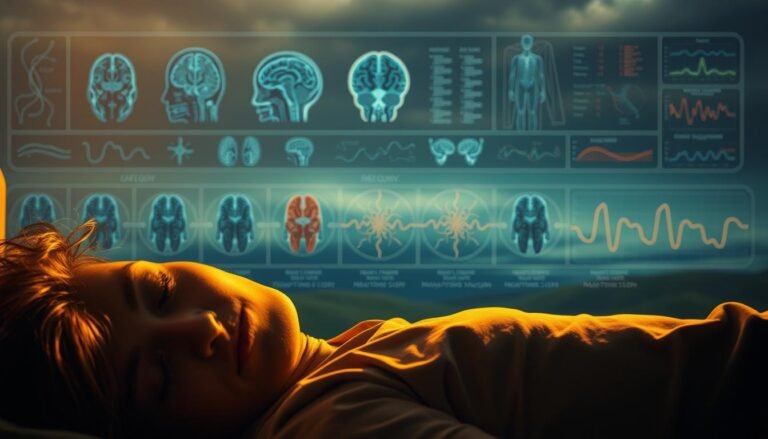
Quick Answer: Narcolepsy is a lifelong neurologic disorder that disrupts the sleep-wake cycle, causing overwhelming daytime sleepiness. In type 1, it also causes sudden muscle weakness called cataplexy. About 1 in 2,000 people have it, per the AASM. A sleep study and a daytime nap test confirm it.
Tired every day and not sure why? Read the signs you have a sleep disorder.
What Is Narcolepsy?
NINDS calls narcolepsy a long-term brain disorder that disrupts the sleep-wake cycle. The AASM says it is lifelong and that people feel overwhelmingly tired, sometimes with sudden muscle weakness. The sleepiness often hits like a “sleep attack,” a strong urge to sleep that comes on fast (NINDS).
People with narcolepsy do not necessarily sleep more in total than others, because many wake often at night (AASM). What changes is the timing. In a normal night, people enter REM sleep after about 60 to 90 minutes. With narcolepsy, REM often starts within 15 minutes of falling asleep (NINDS). That is why dream-like events can break into waking hours.
Narcolepsy Type 1 vs Type 2
There are two major types. They differ in cataplexy and in a brain chemical called hypocretin (also called orexin). It helps you stay awake and controls REM sleep (NINDS).
| Feature | Type 1 | Type 2 |
|---|---|---|
| Excessive daytime sleepiness | Yes | Yes |
| Cataplexy | Often present, but a patient with low hypocretin has type 1 even without it | Usually not |
| Hypocretin level | Very low or absent | Normal |
| Severity | Can be more severe | Usually less severe symptoms |
| Earlier name | Narcolepsy with cataplexy | Narcolepsy without cataplexy |
NINDS also describes a rare secondary narcolepsy, which can follow a brain injury to the hypothalamus. People with it may have other severe neurological problems and sleep more than 10 hours a night.
Narcolepsy Symptoms
Symptoms usually begin between ages 7 and 25 (NINDS), most often 15 to 25 (AASM), and they usually worsen over the first few years. The main symptoms look like this:
| Symptom | What It Looks Like |
|---|---|
| Excessive daytime sleepiness | Sleepiness that does not improve with a full night’s sleep. A brief nap may help for an hour or two (AASM). |
| Cataplexy | Sudden muscle weakness triggered by strong emotions such as laughter, fear or anger. The person stays fully conscious. Episodes last seconds to minutes. |
| Sleep paralysis | Unable to move or speak while falling asleep or waking, for seconds to minutes. AASM says it is not linked to an inability to breathe. |
| Hallucinations | Vivid, often frightening visions or sounds when falling asleep or waking. |
| Fragmented night sleep | Waking several times, sometimes for 10 to 20 minutes each time (NINDS). |
| Memory problems | Trouble remembering things because you were not fully awake at the time (AASM). |
Cataplexy may appear weeks or even years after the sleepiness starts. In about 10 percent of cases it is the first symptom. It can be misdiagnosed as a seizure disorder, so describe the episodes in detail to your doctor. For more on the paralysis symptom, see sleep paralysis causes.
Narcolepsy In Children And Teens
Narcolepsy often starts young. NINDS says symptoms usually begin between ages 7 and 25, and the AASM says pediatric onset is common. Sleepiness in young people is easy to blame on late nights or mood.
That is one reason it can take years to find the cause. If your child is very sleepy in the day, falls asleep at school or has sudden weakness with laughter, talk to their doctor. See children’s sleep by age for what is typical.
How Common Is Narcolepsy?
The AASM says about 1 in 2,000 people have some form of narcolepsy. It also says about 50 percent of people with narcolepsy may be undiagnosed, so the true number may be higher. Pediatric onset is common, and diagnosis is often late. The average delay in diagnosis is 8 to 10 years (AASM).
NINDS says it affects men and women equally. People are often misdiagnosed with other conditions, such as psychiatric disorders, so it can take years to reach the right diagnosis.
What Causes Narcolepsy?
The causes are not completely understood. In type 1, the main cause is the loss of brain cells in the hypothalamus that make hypocretin. Research suggests the immune system attacks these cells because of a mix of genetic and environmental factors (NINDS).
NINDS lists these factors:
- A gene variation called HLA-DQB1*06:02, which increases the chance of narcolepsy and is found in most people with it.
- Immune triggers. People with narcolepsy often show antibodies to a recent bacterial infection such as strep throat, and new cases rose after the 2009 H1N1 flu epidemic.
- Family history. Most cases are sporadic, but up to 10 percent of people with type 1 report a close relative with similar symptoms.
- Rarely, a brain injury, tumor or disease in the regions that control wakefulness and REM sleep.
Do Naps Help?
A short nap can help for a while. The AASM says that after a brief nap you may feel alert, but the sleepiness returns after an hour or two. In type 2, you may nap for a couple of hours and wake refreshed, then feel tired again soon after. Naps do not replace treatment, so talk to your doctor about a plan.
How Is Narcolepsy Diagnosed?
NINDS says diagnosis takes a clinical exam and a detailed medical history, and that visiting a sleep medicine specialist is often necessary. The usual path looks like this:
- The doctor does an exam and may ask you to keep a sleep journal for one to two weeks.
- An overnight sleep study (polysomnogram) records brain activity, muscle movements, breathing and eye movements. It shows whether REM sleep begins too early and checks for sleep apnea.
- A multiple sleep latency test (MSLT) measures how quickly you fall asleep and whether you enter REM sleep.
- Sometimes a lumbar puncture measures hypocretin-1 in the fluid around the brain and spine.
Both the overnight study and the nap test are required to establish a diagnosis (NINDS). Other conditions are often mistaken for narcolepsy, including sleep apnea, circadian rhythm disorders and restless legs syndrome (AASM). Learn more in what happens during a sleep study.
Sleep apnea is on that list, so see obstructive sleep apnea symptoms if you snore or gasp at night.
Narcolepsy Treatment
There is no cure, but symptoms can be managed with a combination of medicines and lifestyle changes. Most treatments target symptoms rather than the underlying disease, and it often takes a long time to find the right combination (NINDS). Your doctor chooses and adjusts the medicines, so we do not list them here, and we do not give doses.
NINDS adds two points. People with narcolepsy have a higher risk of heart disease, so heart health should be checked regularly. It also reports that in 2026 the FDA approved a new medicine for narcolepsy type 1 in adults. Ask your doctor whether it applies to you.
Living With Narcolepsy: Driving And Safety
Narcolepsy can interfere with eating, walking and driving. The AASM says operating a vehicle with untreated narcolepsy can be dangerous and tells readers to check their state driving laws. Cataplexy episodes are not dangerous as long as you are in a safe place, NINDS says, and symptoms can improve over time but never go away completely.
If narcolepsy goes untreated, NINDS says it can interfere with emotional well-being, social interactions and the ability to think clearly, which can affect school and work. Related conditions can overlap, including REM sleep behavior disorder, which NINDS says may be a sign of narcolepsy.
For daily habits that protect sleep, see sleep hygiene 101.
When To See A Doctor
See a doctor if you feel overwhelmingly sleepy in the day despite enough sleep, fall asleep suddenly, or have sudden muscle weakness with strong emotions. MedlinePlus also says to contact your provider if treatment is not working or new symptoms appear (MedlinePlus).
If you nod off while driving, stop driving and get help soon. A sleep specialist can arrange testing.
FAQs About Narcolepsy
Is Narcolepsy The Same As Being Very Tired?
No. Other conditions, such as sleep apnea, often cause daytime sleepiness. The AASM says those are often mistaken for narcolepsy, so testing matters.
Can Narcolepsy Go Away?
No. NINDS says once narcolepsy develops, a person has it for life. Symptoms can improve over time but never go away completely.
Is Narcolepsy Genetic?
Mostly not. The AASM says it may run in some families, but most cases are not genetic. NINDS says up to 10 percent of people with type 1 have a close relative with similar symptoms.
Do People With Narcolepsy Sleep More?
Not necessarily. The AASM says total sleep time may not differ much, because many people wake often at night.
Does Narcolepsy Affect Men And Women Differently?
No. NINDS says narcolepsy affects men and women equally.
Can You Drive With Narcolepsy?
Check your state driving laws and ask your doctor. The AASM warns that driving with untreated narcolepsy can be dangerous.
Your Next Step
Plan the length and timing of a nap around your day. The calculator is a planning aid, not a treatment.